Author: Friends of Cascade-Siskiyou National Monument

Public Scoping Comments Due – Special Recreation Permits

 Map for proposed Bike Race (Page 4 -  Public Scoping  publication ).
Map for proposed Bike Race (Page 4 – Public Scoping publication ).

Public comments for Special Recreation Permits for the Cascade-Siskiyou National Monument are due on July 13, 2017 to BLM Medford. We are now in the scoping phase of the environmental analysis required by the National Environmental Policy Act (NEPA). The desired outcome is identification of key issues that should be considered by the Cascade-Siskiyou National Monument (CSNM or Monument) in regards to special recreation permits. Only a limited subset of such permits are currently under consideration. See the Publication (Public Scoping – Special Recreation Permits) and Maps. This means that any comments you choose to submit will be used to develop issues, mitigation measures, or alternatives as appropriate. Comments that clearly articulate site-specific suggestions, issues, or concerns are the most useful.

Public disclosure. Before including your address, phone number, e-mail address, or other personal identifying information in your comment, be advised that your entire comment – including your personal identifying information – may be made publicly available at any time. While you can ask us in your comment to withhold from public review your personal identifying information, we cannot guarantee that we will be able to do so. We will make all submissions form organizations or businesses available for public disclosure in their entirety.

We look forward to working with you to ensure the protection of the Monument.

Comments Due Date. Please submit your comments by July 13, 2017.

Your comments should be e-mailed to Lyndsay Theurer at this email address: ltheurer@blm.gov

or mailed to:

Bureau of Land Management Medford District Office Ashland Resource Area
Attn: Lyndsay Theurer
3040 Biddle Road

Medford, OR 97504

Electronic submission of comments is strongly encouraged. Thank you ahead of time for your interest and participation.

Lyndsay Theurer
BLM Medford Office
 

When Advocacy Becomes Urgent

As far as nonprofits go, the Friends of the CSNM is not an overtly political organization and only weighs in when the board of directors feels that it is appropriate and important to the protection, restoration, and conservation of the monument.      

Our friends group generally works cooperatively with the BLM and the Department of the Interior and advocates for budgets, staffing, environmental education programs, and anything that advances monument efforts.      

For example, the Friends formally supported the expansion and felt that a larger science-based monument would better protect the “objects of biological interest” that were not well understood at the time of the original designation.        

Now the Friends stand strongly in support of the monument in light of President Trump’s effort to “review” 27 monuments, including ours, designated under the Antiquities Act.  

We ask our members and supporters to stand with us and take action by the July 10 deadline. We will have a booth at the Ashland Fourth of July Celebration and other local events and can help direct you to the many ways to help us with this effort.

Our website also has Take Action link directly to Department of Interior comment form.

Howard Hunter
Advocacy Chair, Friends of Cascade Siskiyou National Monument


Nationally syndicated columnist Dr. Michael W. Fox (Animal Doctor) writes several compelling reasons for his support of the Cascade-National Monument expansion in his June 25, 2017 column:
     “Across the North American continent, this and other bioregions rich in biodiversity need CPR (conservation, protection and restoration). Spiritually, these places are sacred. Scientifically, they are unique habitats rich in animal and plant diversity essential to sustain our need for clean air and water and to help correct and stabilize climate change. Economically, they are a biobank for society, not only for tourism, but also for biologics and microbiota of potential medical, agricultural and other industrial use. Ethically, they are monuments of Earth’s creation that society must cherish — if not for nature’s sake, then at least out of enlightened self-interest.”


​Friends Hire First Staff Position

Welcome Shannon! Our new Community Partnerships Director.

In January 2017, the Friends received a major donation from the Elizabeth G. Maughan Charitable Foundation to support and develop our capacity building efforts over the next two years.  

 Shannon Browne
Shannon Browne

The Friends hired Shannon Browne, a current graduate student with the SOU Environmental Education program and last year’s stellar Student Board Member, to head this effort on a half-time basis. Shannon is a Pacific Northwest native, with a major affinity for the outdoors and conservation. She comes to us with a strong professional background in marketing, interpretation, and outreach.  Previously,  she worked with the National Park Service at Crater Lake and Oregon Caves, as well as with the Sierra Club in San Francisco.

Shannon will work to build capacity with new and diverse constituents and organizations.  These efforts will play a vital role in increasing our visibility and outreach services to communities surrounding the monument.  

Join us in welcoming Shannon as she works to expand the Friends’ reach of engaging people to understand, and act to conserve, the biodiversity that makes Cascade-Siskiyou National Monument so special.

We thank the Elizabeth G. Maughan Charitable Foundation for their confidence in our mission to support the protection, restoration and conservation of Cascade-Siskiyou National Monument through service, advocacy, and education.

The Science of Sketching Clouds with Sarah F. Burns

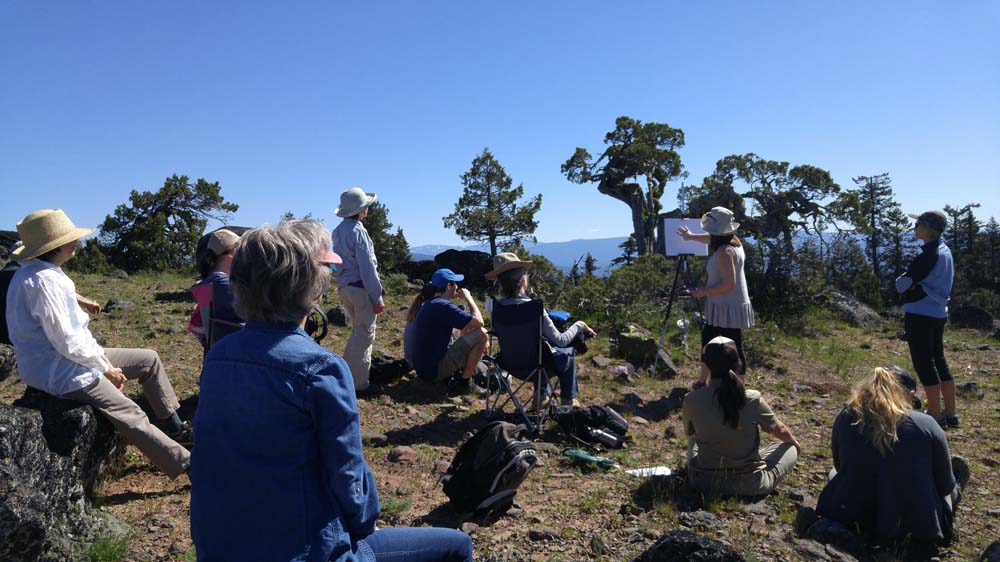
On a bright Saturday morning in May, we sixteen headed south from Hobart Bluff. Our mission: to find inspiration within the diverse bioregion that is the Cascade-Siskiyou National Monument. From the start, we appeared to have our work cut out for us. Most adventurers would have delighted in the clear blue skies stretching from horizon to horizon, but not we.  We were in search of clouded vistas.      

 Pilot Rock view with Sarah Burns' Hike & Learn sketch group in search of clouds, on Hobart Bluff. John Ward photo, May 2017
Pilot Rock view with Sarah Burns’ Hike & Learn sketch group in search of clouds, on Hobart Bluff. John Ward photo, May 2017

Local artist, Sarah F. Burns, would be our guide through our artistic journey. She struck out south from the trailhead toward a rocky overlook that she had visited in the past.  She had great reason to return. After a short hike our group found itself looking out, on one side, over Pilot Rock toward Mt. Ashland and toward Mt. Shasta on the other. As we took in the scenic panorama, small patches of snow could be seen, hiding from the warm sun, in the shade of large conifers. The view was accompanied by a melody of songbirds, including at least one Olive-sided Flycatcher.      

 Grizzly Peak and Cumulus Clouds.  Painting by Sarah Burns
Grizzly Peak and Cumulus Clouds. Painting by Sarah Burns

Sarah set up her easel and gave a thorough sketching demo, with tips and tricks of how to immerse oneself into the sketch without falling into common pitfalls. She discussed how to frame an image for composition, how to use an outstretched thumb to determine scale, and then keep the original idea of your sketch in mind as you work out the smaller details.      

We each then found our own inspirations and comfortable seats among the rocks, and set out on our sketching with hopes that the clouds would continue building on the horizons. It was not long before we were immersed in our processes, occasionally taking short breaks to meander about taking in views and observing our fellow hikers’ works. Our wishing and positive energy paid off as small puffs of stratocumulus clouds built up along the horizons for us to incorporate into our sketches.         

In no time at all, it was nearing time for lunch and time for us to head back down the mountain. We each made a few final touches to our sketches, snapped some reference photos for future inspiration, and began to pack our artist tools back into our daypacks. After pausing briefly for a group photo, our gathering was joined by a brightly colored crab spider for us to marvel at. We then made our way back to the trailhead and dispersed back to our individual lives, sketches in tow.  

Text and photos by John Ward, Hike and Learn Coordinator

Artists and Summer Interns Announced

Artists-In-Residence 2017

Artists Mabrie Ormes, Darlene Southworth and Matt Witt will each spend one to two weeks in residency creating works that represent the natural and cultural resources of Cascade-Siskiyou National Monument.

In June, look for watercolorist Darlene Southworth; and during July, Mabrie Ormes will create a series of paintings along the Grizzly Peak trail. In August, Matt Witt photographs will increase visitors’ understanding and appreciation of the wild lands and biodiversity of the monument. 

Each artist will present a public program. Dates and venues will be posted.


Summer Interns for Interpretive Services

Three summer interns will provide interpretive services to monument visitors. Morgyn Ellis, Elizabeth Schyling and Becky Yaeger are graduate students at Southern Oregon University’s Environmental Education.

Becky worked for Cascade WILDS (Wilderness Immersion Learning Discovering Surviving) and studied to become an Oregon Master Naturalist. Elizabeth has taught and led hikes around Mount St. Helens. Morgyn served as student boardmember for the Friends of the Cascade-Siskiyou National Monument; and she coordinated the Friends Research Grant for University Students and the Science Symposium. 

Read more about interns at SOU Environmental Education Current Students Cohort 2016-17

BioBlitz 2017 – Herpetology: SOU Biology Lead Citizen Scientists in the Monument

Birds called through the tall branches of Douglas-fir, white fir, incense cedar, and ponderosa pine that lined the trails of the Cascade-Siskiyou National Monument. Their needles were warming fast, a spicy feast to the nose, as the morning of Saturday, May 20 dawned sunny and clear.

 Dr. Michael Parker, SOU Biology Department Chair, demonstrates how to tie a lasso. TPD photo
Dr. Michael Parker, SOU Biology Department Chair, demonstrates how to tie a lasso. TPD photo

Sixty (60) eager citizen scientists and eighteen (18) student leaders gathered for the Friends of Cascade-Siskiyou National Monument’s third annual BioBlitz. This event was in collaboration with Southern Oregon University, led by Dr. Michael Parker, Biology Department Chair, with his SOU Biology – Herpetology class. The recently melted snow undoubtedly meant abundant snakes and lizards; frogs, toads and salamanders; and even turtles waiting to be found in the diverse habitats of the Monument.     

BioBlitz 2017 – Herpetology is the first large-scale survey of the herpetofauna (amphibians and reptiles) within the Monument, where citizen scientists worked alongside SOU students to document the distribution of the many species of herps within the Monument’s recently expanded boundaries.

 SOU Biology student leader catches a snake in each hand.  Shane Stiles photo.
SOU Biology student leader catches a snake in each hand.  Shane Stiles photo.

Student leaders, distributed amongst nine sites, led participants to diverse ecosystems within the Monument. The Sampson Creek Preserve, Mayfield Gardens, Upper Parsnip Lakes, Baldy Creek, Boccard Point, Agate Flat, Shoat Springs, Box-O Ranch, Jenny Creek (upper and lower), the Oregon Gulch, and Fredenburg Meadow were all systematically surveyed for herps between 10:00 am and 3:30 pm.

Collectively, the groups observed 18 species including 5 lizards, 6 snakes, 1 turtle, 3 salamanders and 3 frogs (including one boreal toad).  By far the most widespread and frequently encountered species was the Western Fence Lizard that accounted for 76% of all observations and was found at all 9 locations. Racers, Southern Alligator Lizards and Western Skinks were also frequently encountered, occurring at 7-8 of the 9 sites surveyed.  

The three least common species encountered were the Striped Whipsnake, Western Pond Turtle and Boreal Toad, each represented by a single individual at a single site. This initial inventory that was collected at the BioBlitz now provide the basis for future surveys and focused research into biodiversity on the Monument, all of which is essential for its protection.

BioBlitz 2017 highlighted the Monument as a community and educational resource, increasing public appreciation of the uniqueness of the CSNM and providing a hands-on opportunity to learn more about it. Participants were excited to visit diverse parts of the Monument they had never been and spend the day in the company of interesting people. One participant remarked, “The event was amazing. I would always come to any of these kinds of events. It really gives folks a chance to learn and get closer to nature.”

 BioBlitz 2017 - Crater Renaissance Academy participants at Boccard Point, with Mt. Shasta Vies. Caroline Burdick photo.
BioBlitz 2017 – Crater Renaissance Academy participants at Boccard Point, with Mt. Shasta Vies. Caroline Burdick photo.

Participants did get close to their study animals, catching lizards and snakes to identify species and sex as well as taking close-up photos of amphibian egg masses and reptile scales to identify later in the lab. The group that visited Boccard Point got to see biodiversity in action. Standing before a sweeping view of Pilot Rock, Mt. Ashland, and Mt. Shasta, Western Fence Lizards and Sagebrush Lizards lounged on neighboring rocks while Cascades’ incense cedar and white fir gave way to Great Basin sagebrush and juniper.

Undoubtedly, the vistas of the Monument, as well as its characteristic flora and fauna, serve as continual inspiration for scientists and recreational visitors alike. BioBlitzes are essential to keeping this fire of inspiration alive. As one participant so poignantly remarked, “Thanks for letting me be a part of this! If only there was more time in a day! (I didn’t want to leave ☺!)”

by Katie Boehnlein, BioBlitz 2017 Coordinator
SOU Environmental Education graduate student

Photo Gallery – BioBlitz 2017 Herpetology. To view captions, hover top right of each photo.

Pictures Prompt a Thousand Words In Defense of Our National Monuments

I had been asking myself what all of us could do to stop the Trump Administration’s threat to abolish or slash 27 national monuments, including our local Cascade-Siskiyou National Monument, when I got an email from Kevin Ebi, a nature photographer in Seattle.

 Pilot Rock in Deep Winter © Matt Witt
Pilot Rock in Deep Winter © Matt Witt

He said he was putting together an e-book that people would be able to view or download free online that would show photographs of each of the endangered monuments. He had been looking at images on my website of the Cascade-Siskiyou National Monument, and wanted to know if I would be willing to contribute some of them to the e-book.

Within a few days, ten nature photographers had agreed to donate our work to the stunning new free e-book, “Land Almost Lost: A Call to Save Our National Monuments.”

 Land Almost Lost: A Call to Save Our National Monuments.
Land Almost Lost: A Call to Save Our National Monuments.

Already, thousands of people have viewed it and then clicked on the links it provides to file a comment with the U.S. Interior Department and contact their members of Congress, calling for preservation of all of our monuments.

I had a big collection for Kevin to choose from, having hiked and photographed in the Cascade-Siskiyou National Monument in every season for the past ten years. I also sent him some images from Grand Staircase-Escalante National Monument in Utah, a spectacular treasure where I had just gone backpacking, and he used one of a prairie hawk soaring high above a cliff at sunset.

Recently, I heard another local photographer quoting the saying, “We don’t take photographs; we are given them.” The same can be said of our public lands. They are protected only because dedicated activists, scientists, landowners, tribal leaders, hikers, hunters, birders, anglers, and other local residents organized and spoke out over many years.

If we want our national monuments and national parks to endure for ourselves, for future generations, and for the huge variety of plants and creatures that live within them, we all have to make our voices heard – today.

by Matt Witt, Photographer
Artist-in-Residence 2017, Cascade-Siskiyou National Monument

Matt has generously allowed the Friends of Cascade-Siskiyou National Monument to publish his photos in our e-newsletter. 

Friends Award Student Research Grants – Summer 2017

University student researchers will once again get a chance to discover and contribute to what we know about the Cascade-Siskiyou National Monument.

Research grants were awarded to Southern Oregon University students Suphasiri Muttamara (Dialects of Pika) and Hope Braithwaite (Dragonflies and Damselflies); and from University of Oregon Alec Sweetland (Geologic Summer Research Investigations). 

The 2017 funding was provided by the Gwladys & John Zurlo Foundation and Friends of CSNM. You can make a donation and help support education about biodiversity in the Monument.

The Friends Research Fund provides research opportunities for university students. Projects must occur in the Cascade-Siskiyou National Monument, and have a supervising faculty member. Topics can be in the areas of sciences, arts and humanities. 

This year’s review committee included: Morgyn Ellis, FCSNM Board Member; Dr. Stewart Janes, Professor of Biology, SOU; Kent Pressman, community member; Charlie Schelz, BLM Ecologist; and Linda Hilligoss, SOU Professor of Education.

Project Descriptions 2017 funded by Friends Research Fund 

Dragonflies and Damselflies of CSNM – $ 1,472
Hope Braithwaite, Graduate Student, SOU Environmental Education
My main objective in conducting this research is to quantify dragonfly and damselfly species distribution and abundance within and among a diversity of aquatic habitats in the Cascade-Siskiyou National Monument.  (Michael Parker, SOU Professor of Biology)

Dialects of Pika (Ochotona princeps) in Southwestern Oregon – $ 580.
Suphasiri Muttamara, Graduate Student, SOU Environmental Education
The project is a study a distinct population of pika in the CSNM using call dialects. Separated populations of this species have different call dialects due to geographic variation and isolation. My hypothesis is that differences in call dialects will reflect the degree of isolation and divergence among populations. This project will be part of my master thesis project. The specific objectives include: 1) Determine differences in call dialects among pika populations from the Cascade-Siskiyou National Monument, Crater Lake National Park, and Lava Beds National Monument. 2) Compare differences to determine the amount of isolation among these populations. (Stewart Janes, SOU Professor of Biology)

Geologic Summer Research Investigations in CSNM – $ 673.
Alec Sweetland, Senior, University of Oregon
Research will include detailed mapping of rock units and contacts found in the High Cascade and Western Cascade volcanic deposits, and investigation into the geohydrology of the spring systems located in the area by measure discharge rates and mapping spring locations. The goal of these projects is to develop a richer knowledge of the geologic history of the Cascade-Siskiyou National Monument.  (SOU Emeritus Professor Jad D’Allura, Geology)

Your gift will support education programs about the biodiversity of the Cascade-Siskiyou National Monument. Thank you!

Friends Response to Executive Order

President Trump has signed an executive order requiring the Department of Interior to review all designations of land under the Antiquities Act that fit the category of being designated after 1996 and having over 100,000 acres of land. The Antiquities Act was signed by President Teddy Roosevelt in 1906 to safeguard and preserve federal lands, objects of scientific interest, and cultural and historical sites for all Americans to enjoy.

No President has ever revoked a national monument and for good reason: such an attack on our nation’s public lands and heritage is deeply unpopular and likely illegal. The Trump administration’s Executive Order to review national monuments could threaten dozens of national monuments including the Grand Staircase-­‐Escalante National Monument, the Bears Ears National Monument, and our own Cascade-­‐Siskiyou National Monument (CSNM).

The CSNM was designated in June 2000 by presidential proclamation under the Antiquities Act. The monument is home to thousands of species, including a few threatened and endangered, such as the Oregon Spotted Frog and Gentner’s fritillary.

 Pilot Rock, Cascade-Siskiyou National Monument. The only monument designated for its biodiversity, established in 2000. Monument boundaries were expanded in 2017.
Pilot Rock, Cascade-Siskiyou National Monument. The only monument designated for its biodiversity, established in 2000. Monument boundaries were expanded in 2017.

“The monument was proclaimed because it’s a place where there’s exceptional biodiversity. The idea that there is a place in the world that has 135 species of butterflies is just magical!,” says Michael Parker, Professor of Biology at Southern Oregon University.

The Cascade-­‐Siskiyou National Monument connects the distinct Oregon ecosystems of the Cascade, Klamath, and Siskiyou mountain ranges into one unique biological corridor that contains species from east and west of the Cascades. The monument offers unrivaled vistas, access to the Pacific Crest Trail, protection for cultural sites, learning opportunities for youth, and year-­‐round outdoor recreation.

National parks, public lands and waters are a critical part of the nation’s economy – especially for rural and Western communities that benefit from the tourism, outdoor recreation and quality of life associated with healthy public lands. They also define who we are as a nation and help to shape a better future by connecting our landscapes to our cultural past.

The Friends of Cascade-­‐Siskiyou National Monument is a non-­‐profit organization that promotes the protection, restoration, and conservation of the Cascade-­‐Siskiyou National Monument (CSNM). The Friends is opposed to any action to revoke or reduce the protections the monument provides to this valuable community asset.

Terry Dickey, Chair
Friends of Cascade-Siskiyou National Monument