Author: Friends of Cascade-Siskiyou National Monument

Exploring Conifer and Shrub Diversity on the PCT Trail with Naturalist Nolan Richard

Starting in Ashland, the day was gloomy. Rain thudded down through gray skies and the chilly air nipped at our hands. Our group had high hopes the rain would become snow at the higher elevation of our destination, a section of  the PCT off of old highway 99 toward Pilot Rock. As we piled into the cars and took off, we found that slowly, the rain dissipated and sun broke through the clouds to illuminate the fresh snow along the roadside. 

Our guide and teacher for the day, Nolan Richard, a local naturalist and seasoned biology teacher, embarked on an introduction to the world of conifers and shrubs. Nolan, with a decade-long devotion to studying native plants along the West Coast, has shared his expertise in the past by teaching classes for the Native Plant Society. His deep interest in Plant Biogeography—understanding the distribution of plant species and communities—propelled our adventure.

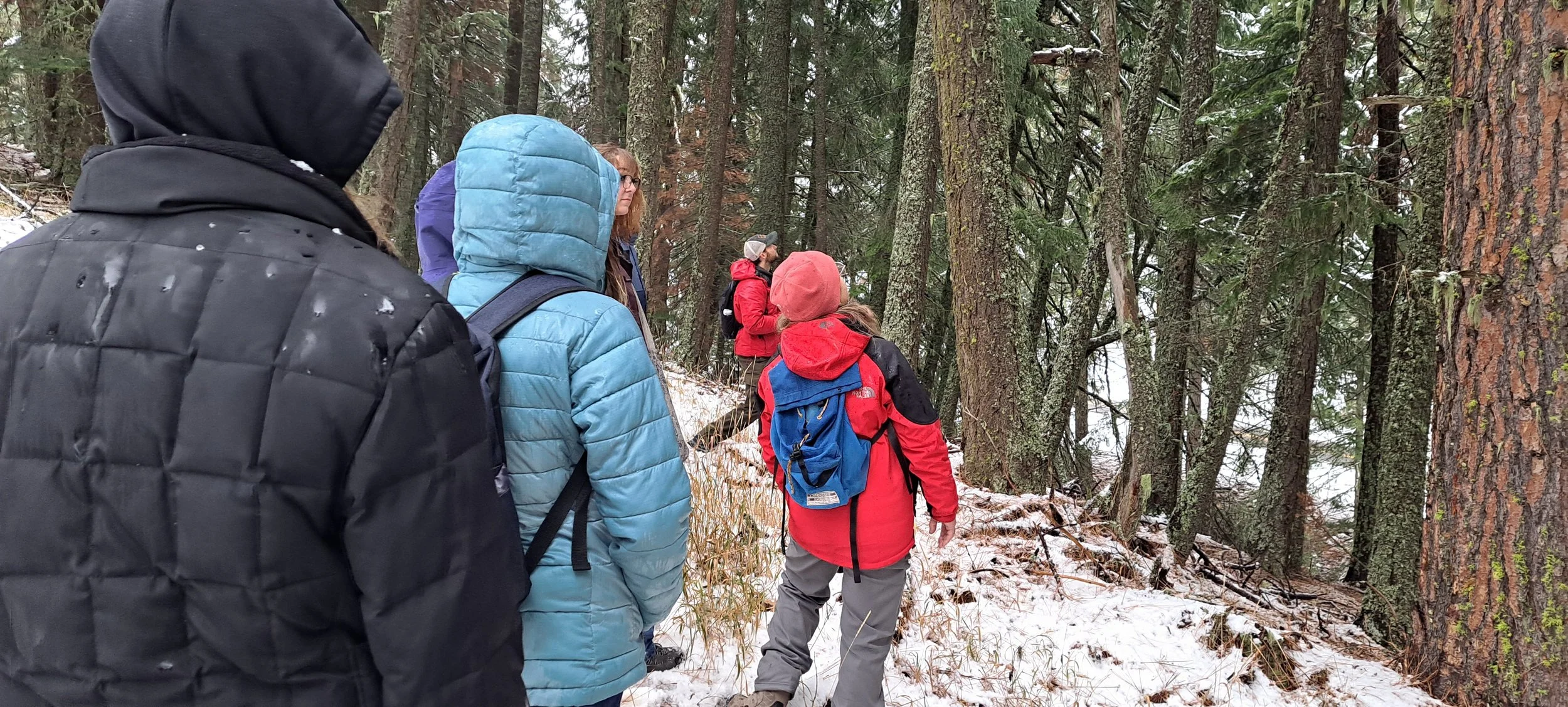
The trees encircled us, prompting Nolan to engage us in identifying the varying conifer species that thrived in this environment. Brushing snow off a couple of saplings, Nolan showcased how to inspect needles to discern between the Grand Fir and the White Fir. As a group, we gathered around, following Nolan’s techniques to identify a White Fir displaying hybridization traits and a Grand Fir with minimal signs of hybridization. 

Our journey led us to a halt in an area teeming with a dense understory. The shrubbery, devoid of leaves and bereft of vibrant colors, posed a challenge in identification during its dormant phase. Nolan assured us that although daunting, it wasn’t impossible. With his guidance, the group keenly observed nuances in branch sizes, textures, and growth formations. Soon, we triumphantly identified snowberry, serviceberry, oregon grape, and several other shrub species amidst the subdued winter landscape.

Nolan often emphasized the importance of identifying conifers and understanding their environmental placement by asking, ‘Why are they growing here?’ In the end, our hike under Nolan’s tutelage was not merely a stroll but an enlightening journey through the diverse world of conifers and shrubs.

Fire History & Ecology of the Monument

By: Zaynab Brown

To watch a recording of Rich’s lecture click HERE

Living in Southern Oregon or Northern California, it is impossible to ignore the reality of fire. In particular, the raging forest fires that blanket the valley floor in a thick, acrid layer of smoke that obscures the mountains and turns the sun red. Each year when the moisture of springs starts to give way to crisp undergrowth and fire season begins, a sense of anxiety informs almost every day; what is going to burn next? It is true that our local ecosystems rely on fire for health and productivity, a fact that the indigenous people have known and used to their advantage for countless generations, yet are these huge, destructive fires the norm? If not, how can we change our approach to fire to work with nature instead of against it? These and other questions are what Rick Fairbanks set out to address in our Fire History and Ecology Hike and Learn. 

Rich Fairbanks has accumulated a wealth of knowledge and interesting stories through his career with the U.S. Forest Service for 32 years in fire management, planning, and silviculture. He is informed by his degree in forestry, his work on the Biscuit Fire Recovery Project, and his experience at his own property where he does a considerable amount of underburning in the mixed conifer forest. It was with his classic dynamism and humor that Rich began to take us through the multi-dimensional picture of fire in the Cascade-Siskiyou National Monument.

It isn’t possible to discuss the ecology of something without considering the plants. When it comes to fire ecology in particular, it is truly the plants that tell the story of an ecosystem that coevolved alongside this force of nature and has the adaptations to prove it. While there are many herbaceous species that also benefit from being burned, we primarily focused our attention on trees. We appreciated the robust fire resistance of the ubiquitous ponderosa pine with its thick bark, self pruning habit, and robust wound response. Other conifers such as the douglas fir, sugar pine, and incense cedar, while not quite as impressive as the ponderosa, still sported fire resistant bark and the ability to easily withstand a low-severity fire. However, fire resistance is not confined just to conifers. Oak trees also wield adaptations to fire in the thick bark of older trees, the ability to resprout from stumps, and how acorns stored in the duff are stimulated to sprout and grow. If you are interested in learning more about the Monument’s oaks, please visit our previous blog post: Oak Trees in the Monument

When the indigenous people first arrived in the region of the present-day Monument, they were faced with an environment that already had intense fire activity. That left them with a choice: React to fires started by lightning or work with this natural phenomenon and pick up the torch. They chose to make friends with fire and learned how to predict and wield it to manage the landscape. When European colonists arrived in the area, they did not recognize the important role and invaluable knowledge of the indigenous people in the management of the landscapes that they took for granted. This led to a period of fire suppression that we still experience today where smaller, low severity fires are not allowed to burn and huge, high severity fires are now ripping through the dense vegetation spurred on by hotter and drier summers.

Rich took us on a tour of the science behind wildfires and what causes their behavior including fuels, weather, and topography. Ultimately, the only factor that humans can influence is fuels. It was from there that we learned about fuel categories and how the surface area to volume ratio affects how materials burn. Finally, Rich discussed what he hopes will be the future of fire in the Monument. In his opinion, this future includes a lot more planned fire, mechanical fuel treatment when appropriate, the effective management of noxious weeds, more fire research, and greater support for Minimum Impact Suppression Techniques (MIST). 

We were fortunate to have many attendees in the audience who brought their own experience with fire and botany to the table. Questions ranged from adaptive phenotypes of local douglas fir to the importance and power of community engagement in how fire is managed in our public lands. In particular, we discussed the importance of MIST in preserving the character and value of wild places that would otherwise be damaged due to heavy-handed suppression techniques.

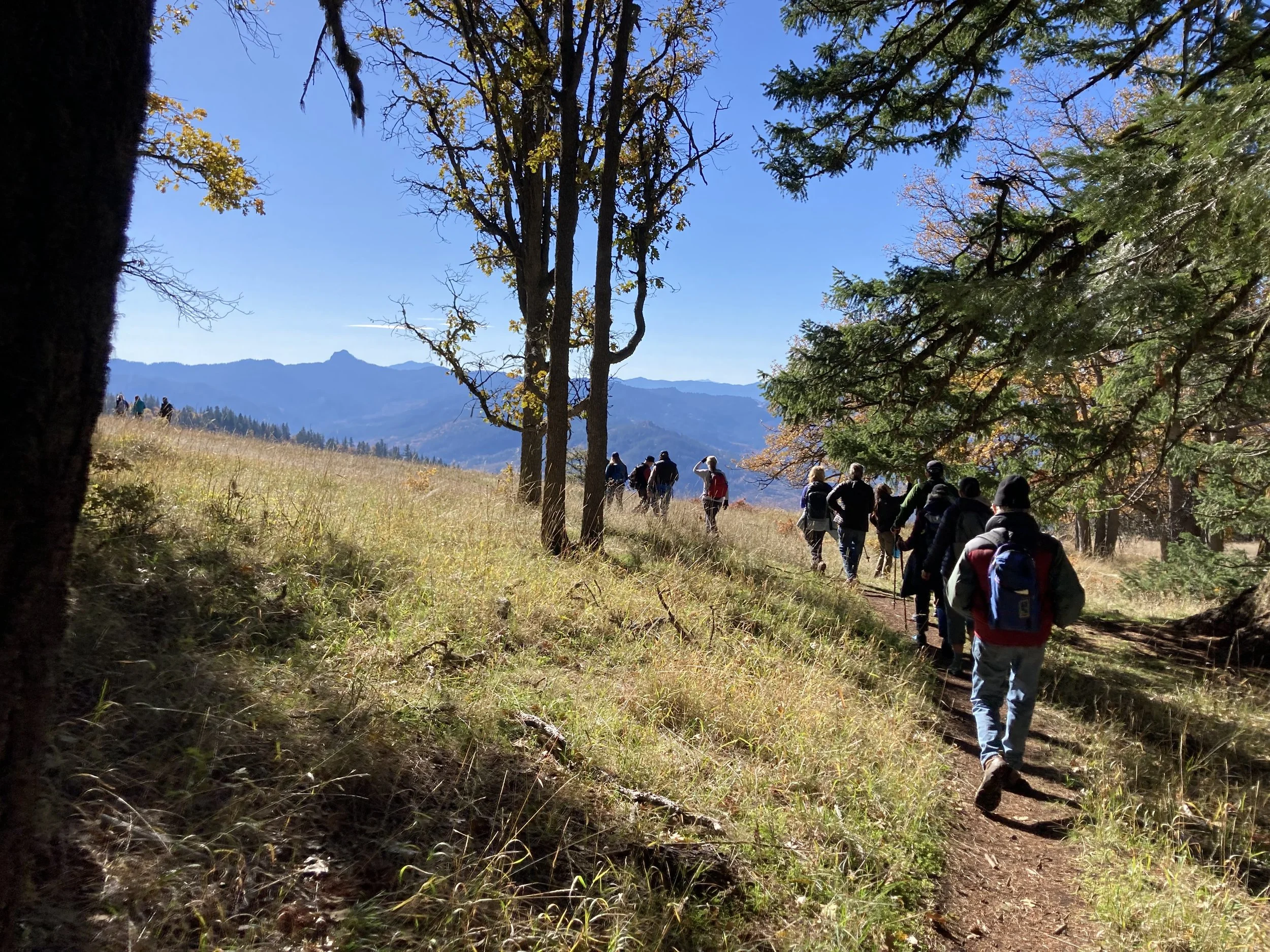
It was with enthusiasm that we all gathered at the trailhead to the Green Springs Mountain Loop trail in the Monument the next day. Despite the discussion of the possibility of snow, the weather could not have been more beautiful. Warm sun shone down and made us a little too warm for our winter jackets and the shade had just enough chill to keep us on our toes. With an impressive group of 17 people, we began to snake our way down the trail. Rich, who helmed our educational adventure, stopped us along the way to quiz us on conifer identification and to admire old-growth Douglas firs casting cool shadows from above. 

As we walked along the relatively popular trail, we were stopped just as frequently by participants who had insightful questions or spotted plants that they wanted to share with the group. It made for slow going, but often the best hikes are the ones that meander and pause frequently to notice the little things. 

We emerged from the trees and found ourselves gazing out at an incredible vista looking down into a valley. The golden meadow stretched into the horizon before giving way to mighty blue mountains. It is here that we turned right and crossed through a grove of oak trees, arranged in a “fairy ring.” Rich stopped to tell us that this was a tell-tale sign of fire where an oak had been burned and then resprouted around the trunk. Most likely, if you were to look carefully, you could find charred bits of oak in the center. But this was not our final destination. Soon, we found the real goal of our detour: A fire refugia. 

Fire refugia are unique places that are protected from high severity fire by topography, microclimate or fuel conditions and allow individual trees to reach a very old age. The centerpiece of this particular refugia were towering ponderosa pines and douglas firs. As we approached, their true age and size were humbling. People often make pilgrimages to the redwoods to witness trees that evoke a sense of wonder, but we had our very own in the Monument. Neon green lichen clung to their trunks and their thick and gnarled bark told a story of past fires that charred but did not kill. Blackened fire scars crawled up their sides. 

We had the honor of eating our lunch below the soaring trees as their branches cast shade like they had for hundreds of years. Due to a random quirk in the landscape, we were able to experience a miniscule slice of what the Cascade-Siskiyou National Monument may have looked like hundreds of years ago when people and fire were able to work together. 

Creating Cascade-Siskiyou Beaverhoods with Vesper Meadow

By: Zaynab Brown

As the saying goes “Even the best laid plans often go awry.” This was the case on Saturday morning when residents of the Rogue Valley woke up to find fall gardens covered in frost. While I was sad to see the end of my tomato plants, the more pressing concern was the day of stewardship the Friends of Cascade-Siskiyou National Monument (FCSNM) had planned in collaboration with Vesper Meadow. A day of wading into a creek wielding shovels and loppers was suddenly less appealing when it felt more appropriate to be wearing a warm hat and mittens. 

The event, called Creating Cascade-Siskiyou Beaverhoods, was to be a day of “behaving like beavers” as volunteers toured along Latgawa and Spencer Creek on Vesper Meadow property and Monument lands to see and tend to the beaver-based restoration projects that were put in place over the last couple of years. Not only would participants get to learn about low-tech, process-based restoration strategies, they would also get a chance to get their feet wet, so to speak. However, with the prospect of those feet also getting frozen, the tough call was made to cancel. 

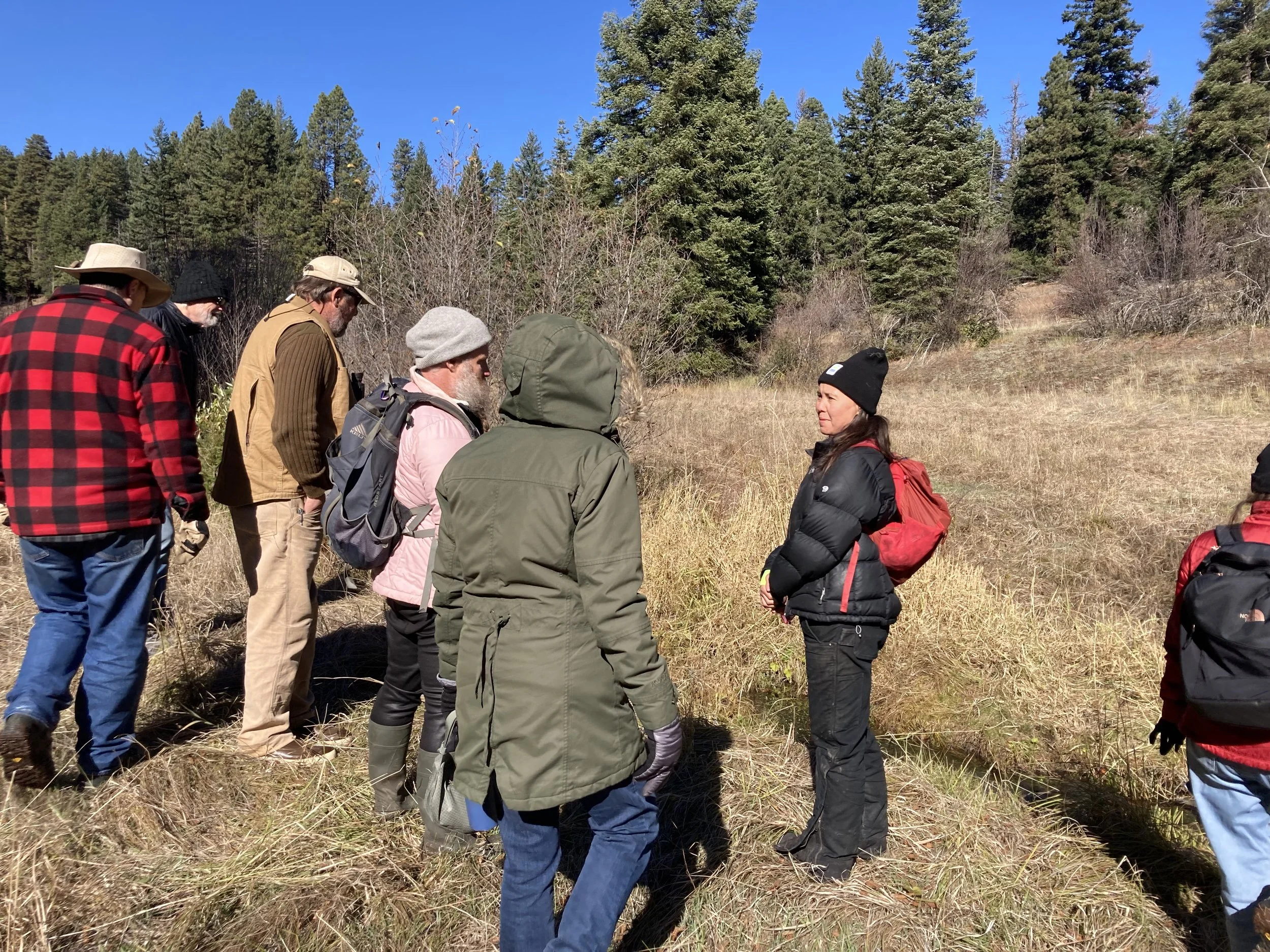
Yet, all was not lost. For those intrepid participants who were up for the challenge of a hike with some snow on the ground, we met at Buck Prairie II at 1:00 PM. There, Stasie Maxwell, FCSNM board member and Indigenous Partnership Programs Manager at Vesper Meadow, led us along Spencer Creek as it passed through the Monument and Vesper Meadow property. There, we were able to observe past structures made from local, natural materials meant to span the creek channel, slowing and spreading the water. We also saw past sloping of the creek bank. As we snaked through the trees, frozen mushrooms peaked out of the snow like time capsules from the last heavy rain. 

Even though our purpose had shifted and the size of our group reduced, the afternoon was filled with insightful questions and joyful curiosity. Zaynab Brown, Program Coordinator for FCSNM, and Stasie painted a picture of a partnership that would further the creation of a landscape that could once again support beavers, the true stewards of our waterways.

A Successful 2023 Annual Celebration

It is a strange feeling, to work for so many hours, days, weeks, and months on something and then have it be over in the blink of an eye. However, that bittersweet feeling is balanced by the joy of witnessing the community coming together. Volunteers were at their stations, the decorations were beautiful, and we could smell the delicious aromas wafting over from where the caterers were setting up. We found ourselves taking a moment to pause and be in awe of the beautiful weather we had, of the still air that barely caused the tablecloths to flutter. 

We knew that having our Annual Celebration in the middle of October would be a gamble. Every day in the week leading up to October 15, Collette, executive director of the Friends, and I would anxiously check the forecast. We dreaded seeing a small, pixelated raincloud posted next to our chosen Sunday and our hopes dashed. Of course, we had a back up plan, but the Pinehurst School gym with its dim lighting and basketball hoops couldn’t hold a candle to an afternoon under blue skies and sunlight. So, as the clock ticked closer to 3:30 PM and the sun gently warmed our skin in t-shirts and summer dresses, we couldn’t believe how lucky we were. 

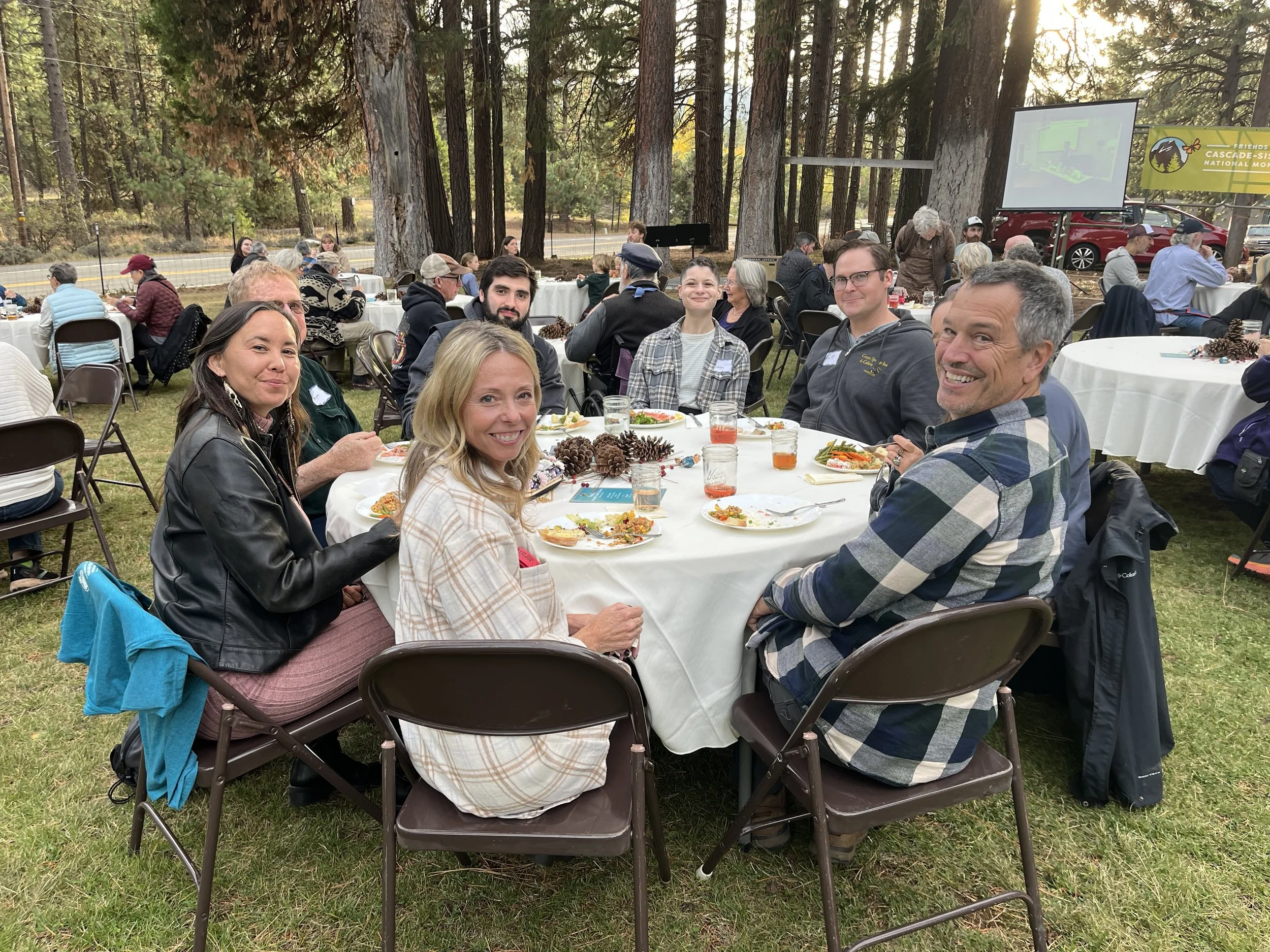
On the lawn in front of the picturesque red school house of Pinehurst School, nestled in the heart of the Cascade-Siskiyou National Monument, stretched a small sea of round tables under the shade of a grove of towering ponderosa pines. Each had a centerpiece crafted from pine cones, needles, and bright red berries collected from the local landscape by the fabulous, Mary Ann and assembled with care by volunteer extraordinaire, Cindy. 

All around us, our board members and volunteers were putting on finishing touches. Stasie Maxwell, board secretary, arranged the raffle table that was overflowing with the generosity of local businesses who donated kindly and enthusiastically to our humble fundraiser. Taylor McAllister, student board member, organized the merchandise table where our new biodiversity t-shirt was proudly on display. Meanwhile Daniel Collay, board chair, and Rob, also a volunteer of extraordinary enthusiasm and muscle power, set up the last remaining chairs and unloaded plates and glasses that were generously lent to us by Willow-Witt Ranch. There was a final hush as the last detail was moved into place. The table was set, both literally and figuratively, for the 2023 Friends Annual Celebration. 

The atmosphere was friendly and jovial as the lawn was slowly filled with attendees. The guitar music of Greg Starbird drifted through the background. Even though many people came from different towns and led different lives, they all shared something in common: A love and appreciation for the Cascade-Siskiyou National Monument. Walking around, we saw many familiar faces from this past year’s Hike & Learns, Sunday Hikes, and Stewardship Days. The same people who we spent hours together sweating and removing barbed wire fencing, or stooped over an old stump examining a burn scar, now enjoyed refreshments and reflected on a year well spent. 

Mike, another amazing volunteer, was armed with a practical apron and broad smile, offering an “arm’s length” of bright red raffle tickets as people strategically made their selections and put their tickets into metallic silver cans. On a nearby table, a crowd was clustered around a map of the Monument where pictures of beavers waited along the margins to be moved onto the map in exchange for a small donation. Teresa Coker, board member, explained that it was in support of a future “Beaver Scavenger Hunt ”, an important first step in the Friend’s new stewardship program in partnership with Project Beaver.

Soon enough, armed with warm spiced cider and a colorful salmon dinner from Maren Faye catering, everyone found their seats. The lucky raffle winners were drawn and then Collette took the stage. It isn’t usually easy to distill an entire year of an organization’s changes, accomplishments, and future goals into a succinct and interesting presentation but Collette did so admirably. Not only did she highlight our successful programming, including our Hike & Learns, Friends Research Fund, and Monument Days with the Crest, she also celebrated the hiring of Program Coordinator, Zaynab Brown, and temporary Operations Manager, Meaghen O’Rourke. We even got to commemorate our new office! Finally, Collette addressed what all of the cute little beaver cut outs had been hinting at: Our beaver habitat stewardship program in 2024. With this, Jakob Shockey took the stage. 

It is hard not to fall in love with beavers when you spend just a little time learning and getting to know them. This is particularly true when they have an advocate such as Jakob Shockey, executive director of Project Beaver. Jakob took us on a journey through the historic presence of beavers in our local area and in the Cascade-Siskiyou National Monument. Not only were we all impacted by the tragic loss of their numbers due to removal by white settlers, we were also impressed with their promise for the future of riparian restoration. From table to table there was a palpable excitement, a drive to help these unassuming rodents take charge of our waterways once again. 

As Jakob wrapped up his presentation, the air had taken on a decided chill and the sun had disappeared quickly as it so often does in the mountains. The Friend’s 2023 Annual Celebration had officially come to a close and attendees claimed their raffle prizes and headed back to their vehicles for a curvy drive back down to the valley. However, the night wasn’t yet over for our volunteers and their families. Quickly, everyone jumped into action and started taking down decorations, piling tables, and putting back chairs. Even the small kitchen in the school was bustling with brave volunteers tackling piles of dishes. It is always surprising to me how an event that took months of planning and hours of setting up can come down in what seems like mere moments.

Soon, it was quiet and dark, the moon hidden behind clouds. The towering ponderosa pines were no longer casting a shadow but their presence was noted nonetheless. The guests and volunteers had gone home, but all left with a renewed sense of community and anticipation for what was to come.

American Settlers’ “Back Door to Oregon”: A History of the 1846-1860s Applegate Trail

May 12 & 13 – Applegate Trail Hike & Learn

On Friday, May 12 a group of history lovers converged on the Ashland Co-op Community Classroom to hear a presentation by Jeff LaLande on The Applegate Trail – American Settlers’ “Back Door to Oregon.” As far as local history buffs go, it doesn’t get much more impressive than Jeff. After moving to Southwestern Oregon from Washington, DC in 1969 –right after graduating from Georgetown University— he immediately dove into the region’s past as well as its geology, flora and fauna. He earned a master’s degree in archaeology from Oregon State University and then a PhD in American History from University of Oregon. Jeff is now retired from a thirty-plus year career as an archaeologist with the US Forest Service on the Rogue River-Siskiyou National Forest. An adjunct professor of history at SOU for over twenty years, he’s authored several books (including the just-published Jackson County Rebellion: A Populist Uprising in Depression-Era Oregon) and a number of articles published in quarterly journals. 

Jeff deftly guided us through an overview of the Applegate trail and the men who were instrumental in founding it. It was first laid out in 1846, with its most active period being between 1846 – 1860 by a party including Levi Soctt, David Goff, John Owen and brothers Jesse and Lindsay Applegate. It was known to Oregonians as Applegate’s Cutoff, the Southern Emigrant Road, South Road, or Southern Road and was intended to be a southern alternative to the Oregon Trail that was safer, quicker, and more secure. While it did not necessarily deliver on all of those promises, it was very significant in the settling of the Rogue Valley in the 1850s. Today, portions of the trail are paralleled by I-5 and Highway 66. It was even designated as a National Historic Trail in 1992 by the National Park Service. 

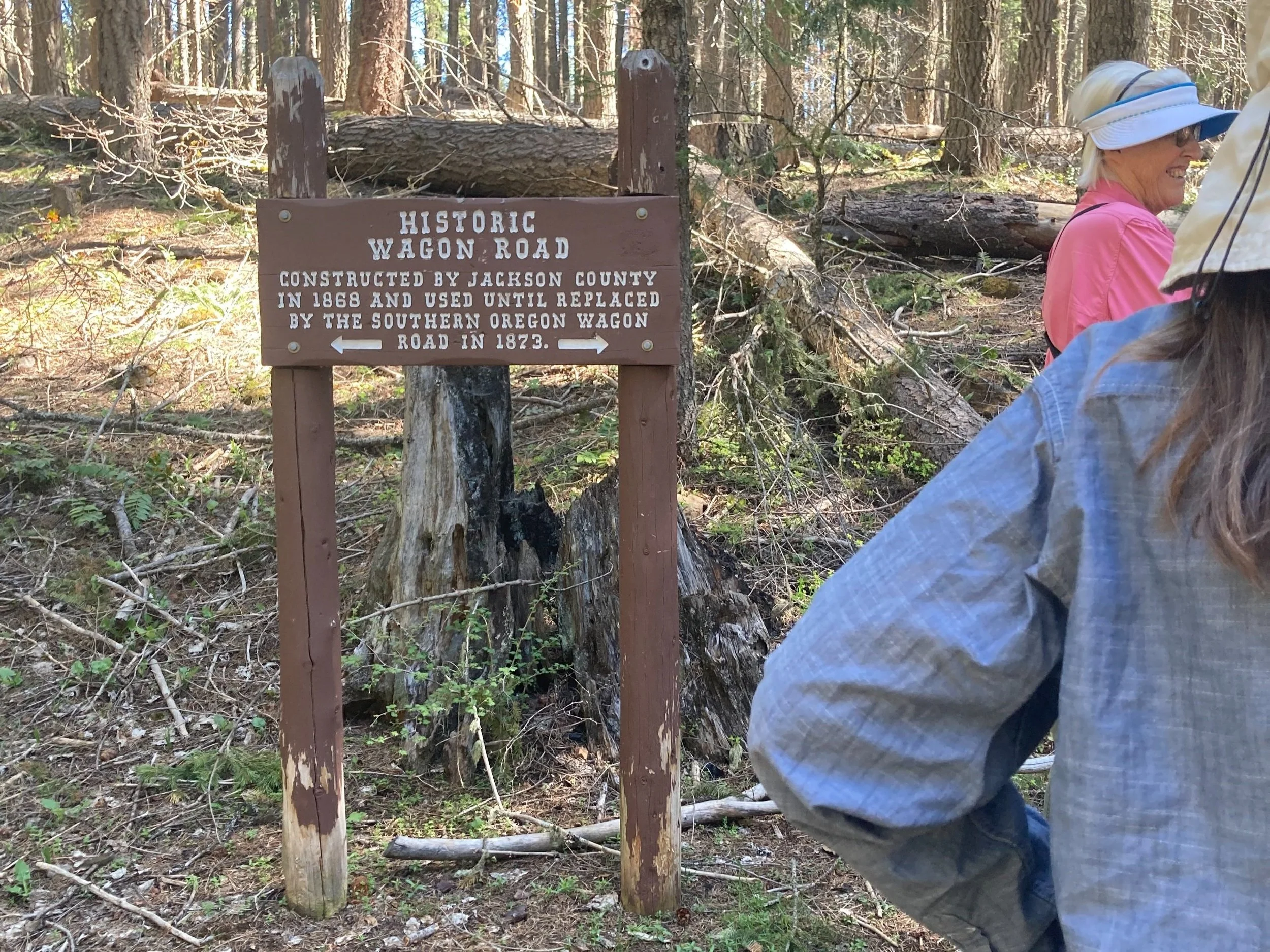
We began our tour on Saturday, May 13 with a caravan of vehicles heading up into the Cascade-Siskiyou National Monument. With Jeff as our leader, our first stop was the town of Lincoln on Highway 66. There, Jeff began the day with an overview of the indigenous people who called the Monument, the Rogue Valley, and surrounding areas home and how the town of Lincoln got its start. Next, we found ourselves at the Tub Springs State Wayside. While the spring itself was dry due to water quality concerns from our very wet winter, Jeff took us up the trail and into the surrounding forest. In addition to some well deserved breaks to do a little impromptu birding, we viewed the Historic Wagon Trail built by Jackson County in 1868 that used a similar path as the Applegate Trail. In fact, Jeff guided us to several areas where we could see remnants of the original trail itself as evidenced by compacted ground and displaced rocks and boulders that had been moved by early settlers clearing a path for their oxen and wagons. 

After stopping for a leisurely lunch alongside the Pacific Crest Trail, we meandered down Tyler Creek Road before stopping at an easily-overlooked site where the Applegate Trail was once again visible to the naked eye! It was a powerful feeling to stand on the same path that was traveled by the original European American Settlers of the Rogue Valley. Some of us reflected that even though it was less than 200 years ago, the world we are familiar with now was vastly different from what they encountered when they first laid eyes on the Valley. 

 Walking directly along the path of the Applegate Trail!
Walking directly along the path of the Applegate Trail!

Finally, we wrapped up our trip with a destination outside of the Monument: The Hill-Dunn Cemetery along the edge of Emigrant Lake. Jeff told us about many of the original settlers that were buried there, including James Howard Russel and his wife Anne Hill Russel as well as many of those who died in the Rogue River Wars from 1853-1854. We learned that it was James and Anne who were responsible for much of the impressive marble monuments represented in the cemetery. 

As we gathered as a group under the shade of a large oak tree, we all expressed gratitude to Jeff for his unsurpassed knowledge of the area. Not only did he make us laugh with his stories and marvel at the beauty of the Monument, he also impressed in us an appreciation for the sometimes-faint footprints of history on the landscape that can help us understand our own place in the unfolding history of our little corner of Southern Oregon. 

Fence Pull at the Green Springs Mountain Loop Trail

It was Saturday, May 20 and we were feeling lucky to have just missed a big heatwave that rolled through the Pacific Northwest, bringing with it temperatures in the 90s and plenty of discontent amongst Rogue Valley residents who wondered what had happened to spring. In fact, the Rite Aid parking lot where we met our intrepid group of fence pullers was pleasant in the 70s with the promise of even cooler weather as we climbed in elevation. It certainly takes a group of people passionate about the Cascade-Siskiyou National Monument to be excited about a day of manual labor and this was evidenced by smiles all around as we introduced ourselves. 

The project of the day was to remove barbed wire fencing from the Monument in an area around the Green Springs Mountain Loop Trail, directly off of the Pacific Crest Trail. The fencing was most likely a relic of when ranchers would graze their cattle in the Monument before it was designated. Unfortunately, while good at keeping cattle corralled, barbed wire fencing is both an impediment to the movement of wildlife through the landscape and possibly even deadly if an animal happens to find itself caught in it. There still remains over ten thousand feet of barbed wire within the Monument, and it was our task that day to reduce that number. 

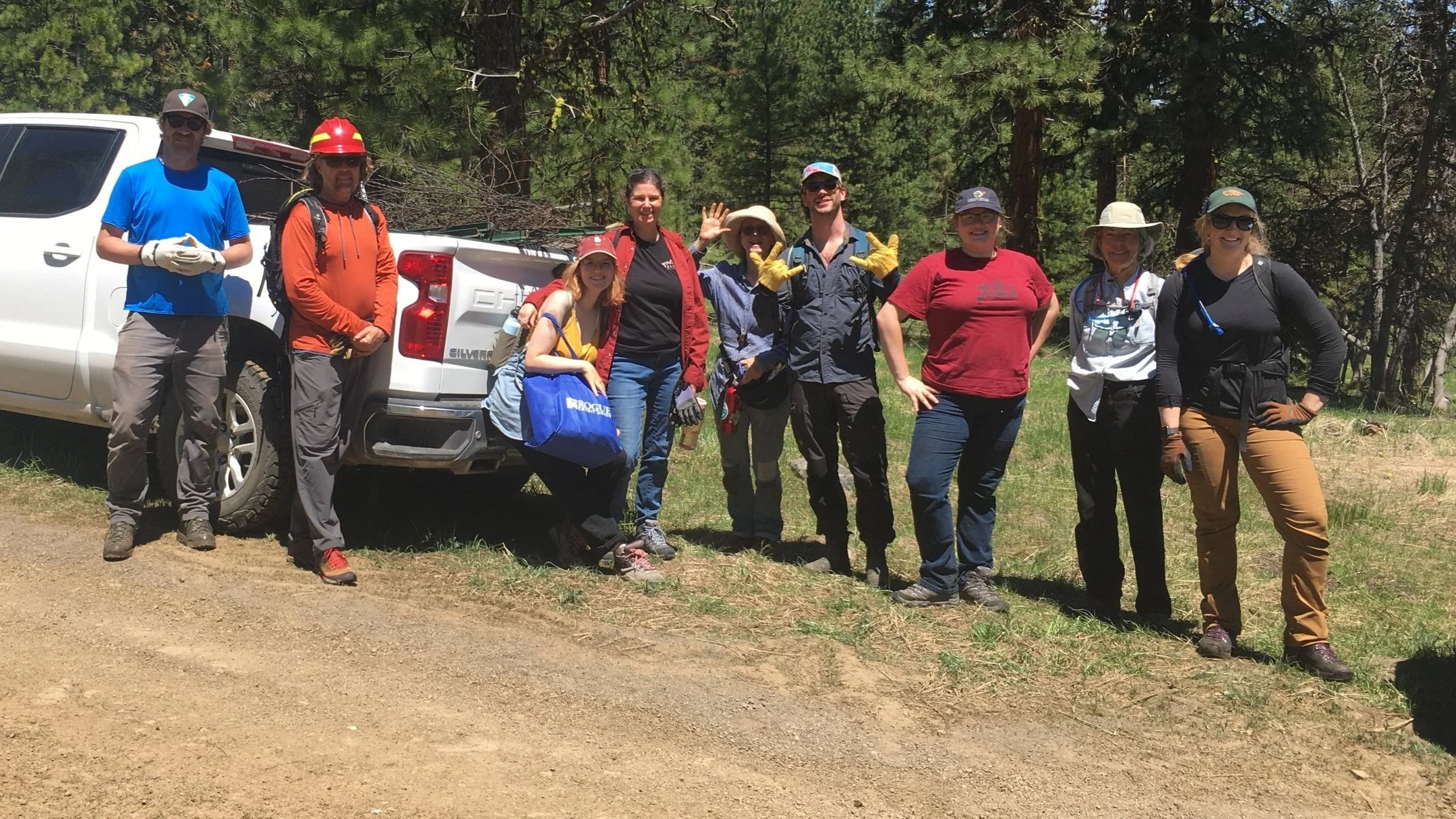
When we arrived at the trail, we realized that we were not the only volunteers out on a Saturday morning. Also working on sections of the trail was a team of people from Pacific Crest Trail Association clearing fallen trees with chainsaws. John Duwe, the Bureau of Land Management (BLM) Interpretive Ranger, and Brian Long, the BLM Outdoor Recreation Planner, introduced us to the section of fencing that we would be attempting to remove that day. They also introduced us to our tools: wire loppers and hand saws. We all fell upon the fence with the enthusiasm of people who had not used hand saws in a while and soon became jealous of the chainsaws roaring in the distance. But despite the sun on our faces –it always feels hotter when you’re working hard– and the old, stubborn wood, we succeeded when a pile of trimmed wire and toppled posts accumulated. 

However, we weren’t done yet! Paying little heed to the upward slope and brush, we began following the line of toppled –and sometimes buried!– wire as it blazed a trail up the ridge. Soon, we all began to experience the satisfaction of making quick progress as we cut wire, parceled it up, and passed it along to be carried out to the trucks. While it is known that barbed wire generally does not appreciate being put into any arrangement aside from a chaotic heap, with some gentle persuasion and determination we managed to roll it into bundles that were less likely to take an eye out. This truly felt like an innovation! 

After a well-deserved lunch complete with Tate’s Cookies and Santa Cruz lemonade, we decided that a final push was what we needed to complete our task, and complete it we did! When it was discovered that only 100 feet remained we kicked it into high gear and employed all of our hard-earned expertise to remove it in only ten minutes. With this last section taken out, we met up with the progress made by the fence pull last year. It was truly a moment of immense satisfaction. 

We all took a last, satisfied look at the loaded pick-up trucks and learned we had removed around 750 feet of fencing that day, along with more than ten thick, wooden posts and many green t-posts. It was a moment to celebrate and we all headed home with the knowledge that we had left the Monument better than when we had arrived. 

2023 Monument Research Symposium

April 6, 2023 – Monument Research Symposium

Every year, the Friends of the Cascade-Siskiyou National Monument is delighted to award a number of grants to undergraduate and graduate students for faculty-supervised research projects that enhance the understanding, appreciation, preservation and/or protection of the Cascade-Siskiyou National Monument. These research projects can, and have, taken many forms including the realms of biology, environmental sciences/education, sociology, arts, humanities, and business. 

An essential component of receiving this grant is the presentation of the students’ research at our annual Monument Research Symposium. This research represents many hours spent in our beautiful Monument gathering data and then countless more analyzing it. To ask our three grant recipients from 2022 to distill all of their findings into a 20 minute presentation is no small feat, but they delivered with flying colors. 

Our first presenter, Thomas Hillard, is an undergraduate student in Earth Science and Biology at the University of Oregon. He worked with faculty supervisor, Jad D’Allura to map out the rock formations in Jenny Creek Falls as well as a region of tuffaceous rocks, debris flow and lava around Pilot Rock. Specifically, he looked at upper oligocene volcanic stratigraphy in the Colestin Formation and Roxy Formation. Thomas gave us a unique insight into how the geology of the Monument can have a stark impact on the distribution of plants and soils via the movement of water. 

 Volcanic Lava Flows - Thomas Hillard
Volcanic Lava Flows – Thomas Hillard

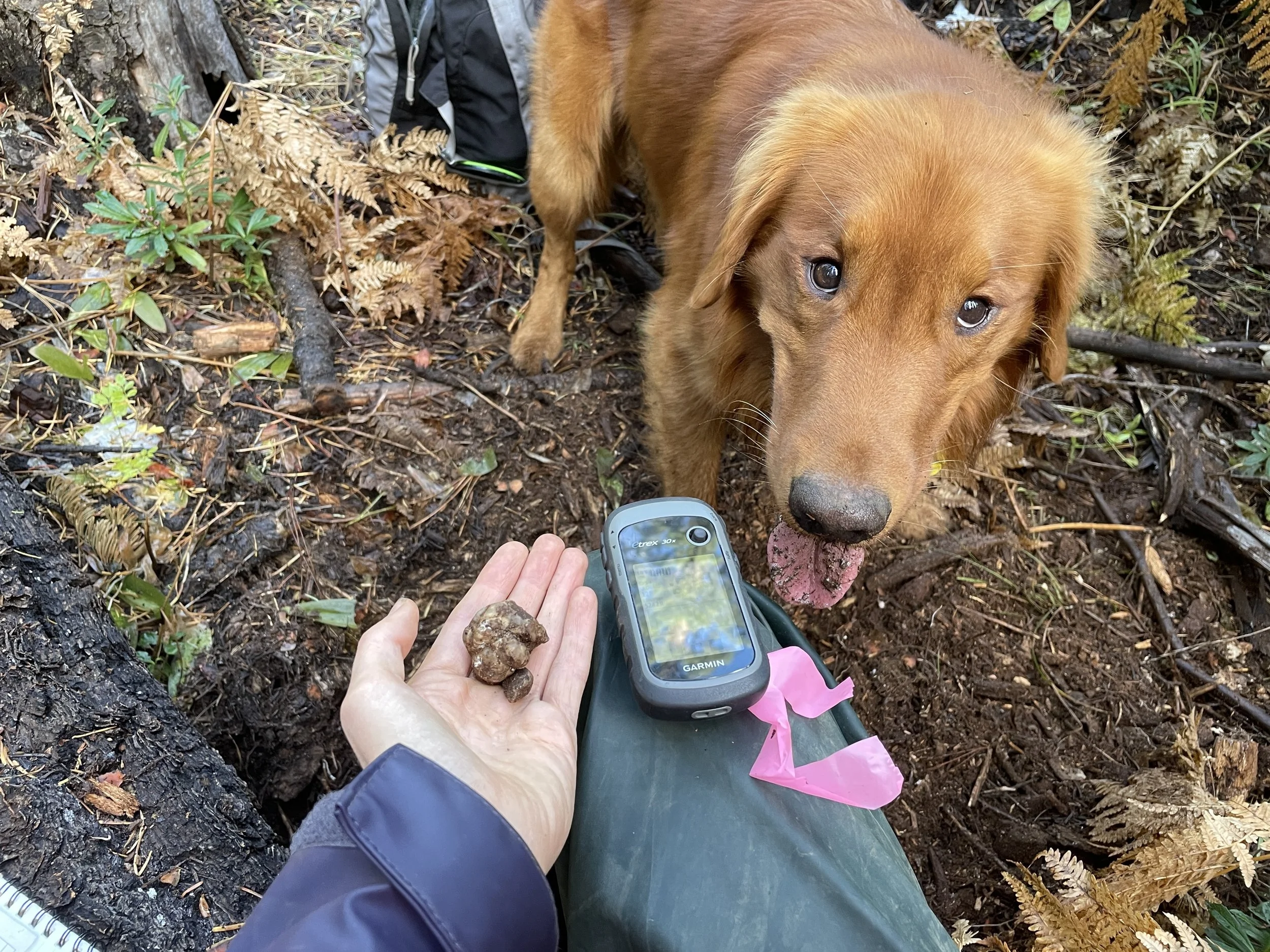
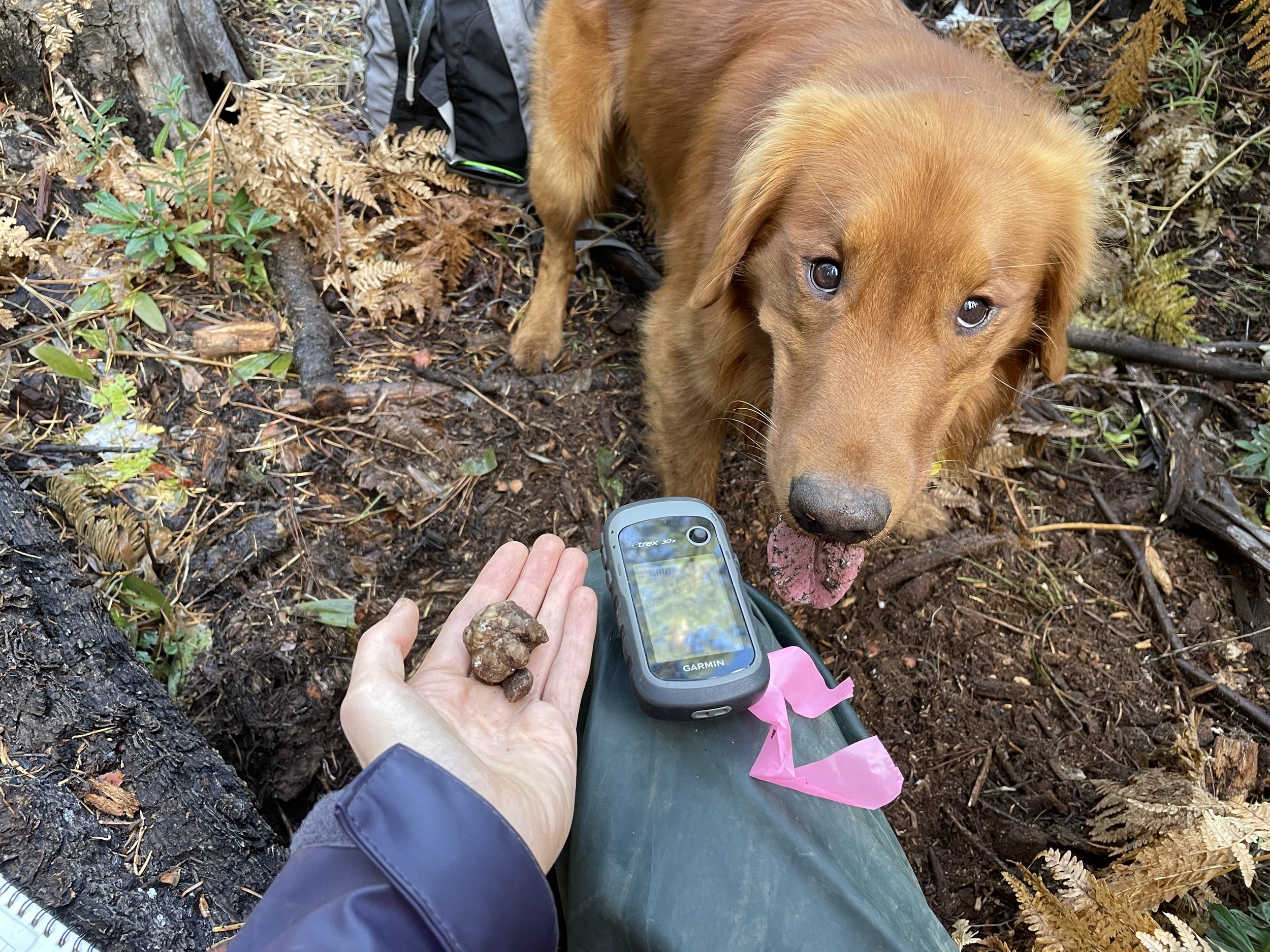
Our second presenter, Hilary Rose Dawson, a Ph.D. student from the University of Oregon, took a departure from geology to focus on biology, but still left us firmly grounded in the soil! Hilary used her Monument Research Grant to explore truffle species found in the Cascade-Siskiyou National Monument. Now, most people’s experience with truffles begins and ends in a culinary context, and while there are certainly a handful of culinary truffles found in Oregon, we also learned about the fascinating diversity of non-culinary truffles found just below the surface. These truffles have scents ranging from artificial banana to burnt rubber and serve a variety of essential ecological functions. However, humans aren’t exactly known for their sensitive noses so it was essential for Hilary –aided by her sister, Heather Dawson–to employ a canine friend named Rye! While not physically present at the symposium, you could definitely consider Rye one of the stars of the show. It was with his invaluable sense of smell, rewarded each time he found a truffle with a throw of a tennis ball, that Hillary was able to catalog around 20 species of truffles in only two forays into the Monument. She hopes to go on another foray with Rye this spring and continue DNA analysis of the truffles she has found, including some possibly undescribed species. 

 Rye finding a truffle! - Hilary Rose Dawson
Rye finding a truffle! – Hilary Rose Dawson

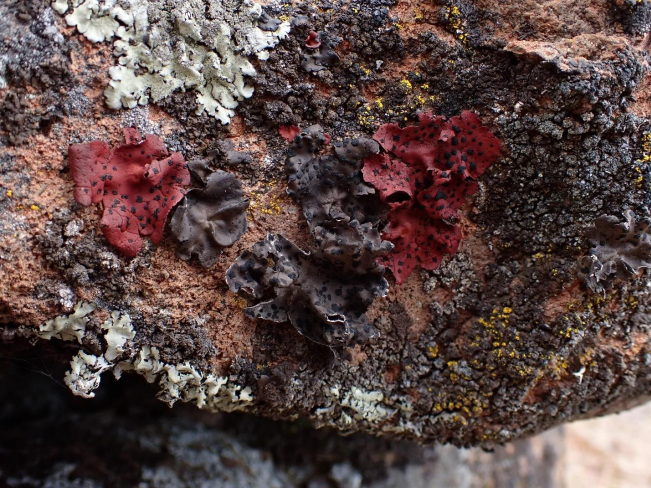
Our final presenter, Heather Stewart-Ahn, a Master’s student in Biology at Eastern Washington University, focused a sharp eye on an often overlooked resident of the Monument: Lichen! Lichen consist of a symbiotic relationship between a fungal partner and photosynthesizing partner, such as green algae or cyanobacterium. In particular, Heather looked at the rare lichen Umbilicaria phaea var. coccinea. This tiny but mighty lichen is most abundantly found on rocks in exposed areas with profuse basalt in proximity to local waterways. However, what really catches the eye is its bright red color, setting it apart from the much more common brown Umbilicaria phaea var. phaea. Through her survey, Heather identified several new sites within the Monument where this lichen is found and opened up many areas for further study including population genetics and distribution models to explore why it occurs in certain places and not others. There is also the basic query of why this lichen is red in the first place! This particular question is further complicated by Heather’s discovery of chimeric thalli, or lichen with both brown and red varieties found on the same thallus. 

  U. phaea  var.  coccinea  (red) and  U. phaea  var.  phaea  (brown) - Heather Stewart-Ahn
U. phaea var. coccinea (red) and U. phaea var. phaea (brown) – Heather Stewart-Ahn

If you are interested in learning more about these projects, the symposium can be watched in its entirety on our YouTube channel at https://www.youtube.com/watch?v=CEePTxlJKnI

With our 2023 Monument Research Symposium a resounding success, we are looking forward to getting to experience the unique projects that students will propose for this coming grant cycle. Applications are now open and information can be found at https://www.cascadesiskiyou.org/programs . The deadline for applications is May 12, 2023 at 11:59 PM PST.

Beginning Wildlife Tracking

February 24 & 25, 2023 – Hike and Learn

We had a full house for our Friday evening lecture despite snowy weather that prevented some from venturing down the mountain. Our leaders, Collette Streight and Robin Bliss-Wagner, kicked off the lecture by explaining that tracking, typically thought of as identifying an animal by looking at prints it left on the ground, is much more than that. We learned that tracking, when done in a holistic way, is about connecting with wild animals, building relationships with them, and understanding the world through their points of view.

Collette and Robin taught us that every animal makes a unique signature on the landscape. A signature is the collection of signs an animal makes when going about its daily life. Examples include tracks, scat, chews, scrapes, lodges, burrows, nests, hair, and feathers. We then learned the six main questions to ask ourselves when we encounter a track or sign to ignite our curiosity and lead us deeper into the animal’s world:

  1. WHO made the track or sign? Was it a male or female? How old was he/she?

  2. WHAT was she/he doing? Stalking, walking, trotting, galloping, leaping, stopping, sitting, turning his/her head?

  3. WHEN was the track or sign made?

  4. WHY was the animal doing what it was doing at that time and place?

  5. WHERE did the animal go? Where is he/she now?

  6. HOW did the animal feel when it made the track or sign? In other words, if this was me, how would I have felt?

Then we explored in detail the first question of tracking – who. We looked at photos, drawings, and field guides to learn about the individual prints and track patterns of many different animals who call the Monument home.

On Saturday, 15 of us carpooled up to the Buck Rock Tunnel trailhead in the glorious sunshine. On the way there, we stopped to examine a gray fox, who unfortunately had been killed by a car the previous night. We noticed its size, color pattern, shape, and then looked closely at the bottom of its feet and its claws before we continued on our way.  

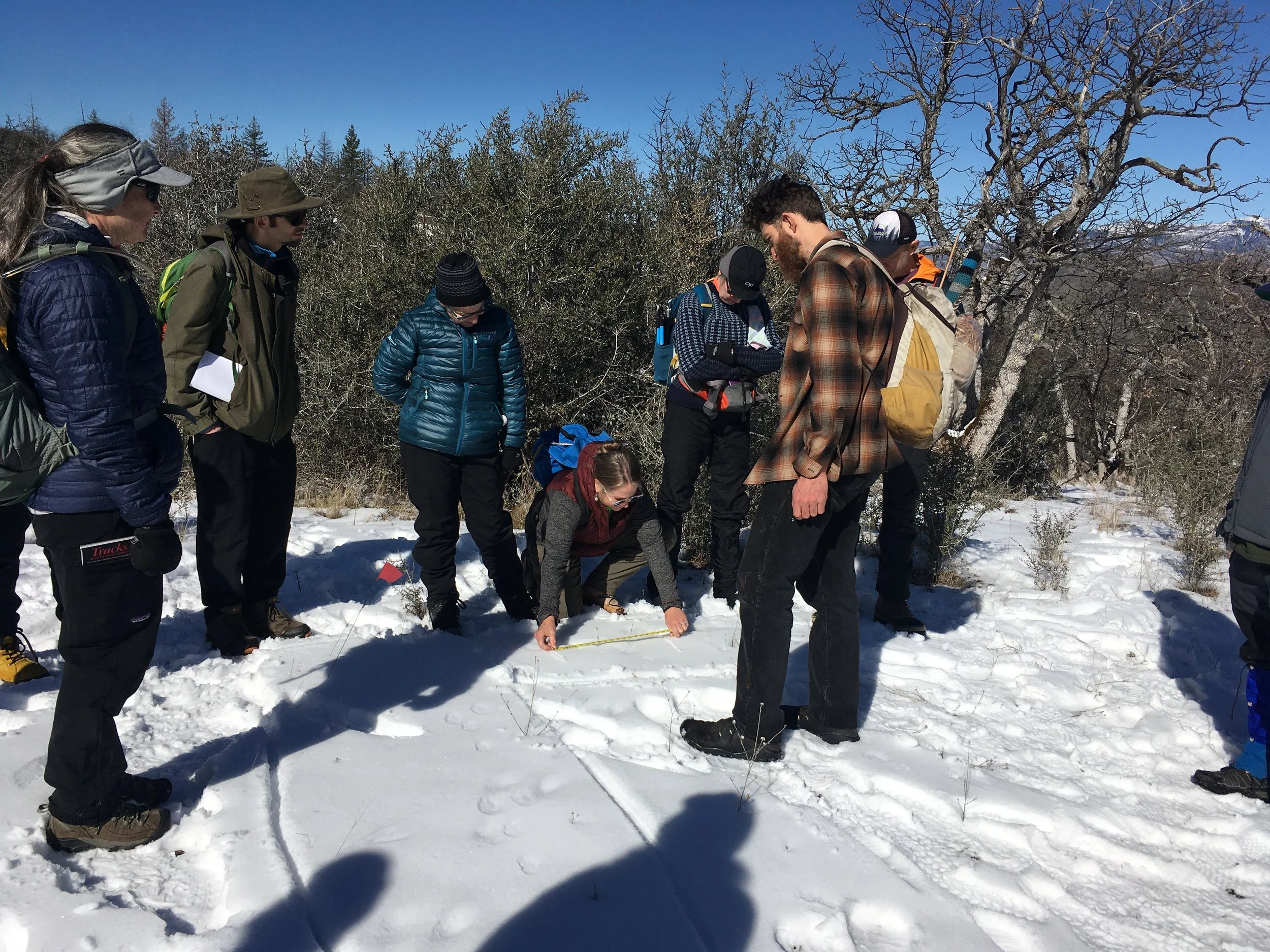
Equipped with field guides, tape measures, notebooks and pens, we explored the wildlife tracks and sign we saw in the snow in the parking lot, on the fire road, down in the ravines, up on the ridges, and in and around trees. We followed mule deer and brush rabbit trails to see where they would lead us. We asked questions, awakened our senses, listened to stories, played a game, and even spent some time pretending to be animals.

All and all, it was a beautiful, fun, and inspiring day during which we learned tools that we can use from now on to connect with and learn about the wild critters who live in the Monument and all around us.