Author: Friends of Cascade-Siskiyou National Monument

Welcome to the Cascade-Siskiyou National Monument: Ranger Recap

By Anna Kennedy
Monument Interpretive Ranger Intern, Summer 2018

It was an honor and a joy to spend this past summer as an Interpretive Ranger at the Cascade-Siskiyou National Monument. Even after spending the previous year exploring the trails as a hiker and a naturalist, there was so much that I had yet to learn about what makes the monument so special.

Having a background in conservation biology and a solid understanding of ecology, I was not surprised when my love and appreciation for the incredible biological diversity grew each moment I spent roving the trails. I was not shocked by my awe at the incredible interdependence of organisms, nor at the shear number of species that one could count hiking through various habitats.

What did come as a surprise to me was the diversity of people that I met on a daily basis, visiting from a wide variety of places and enjoying the monument for a wide variety of reasons. Whether I was staffing the information center next door to the Green Springs Inn, hiking the Pacific Crest Trail, or leading an interpretive program, each and every visitor I met had a unique story to share.

Engaging in conversation with visitors and learning why and how they were enjoying or utilizing their public lands was one of the most rewarding aspects of my summer experience. During evening interpretive programs at Hyatt Lake Campground I had the opportunity to get to know many folks that were camping out, some just escaping the smoke at lower elevations.

While hiking the trails between Hobart Bluff, the Green Springs Loop, and Little Hyatt Reservoir, I met a multitude of PCT hikers, some that traveled internationally to begin their through-hike from the Mexico-California border.

Working with kids during my Jr. Ranger programs was oh-so rewarding as we learned about the diversity of birds that call the Cascade-Siskiyou National Monument home. I got to chat with some folks who decided to stop off at the Green Springs Inn for a slice of pie–some of them had no idea there even was a National Monument in Southern Oregon.

With each and every conversation I got to experience a diverse stories, perspectives, and ideas. Despite the smoke, the Interpretive Ranger team made contact with more than1,200 visitors throughout the summer!

As summer comes to an end and I once again enjoy the monument as a mere hiker and naturalist, I look back with great gratitude for being able to get a taste of what it’s like to be a Ranger. I hold great appreciation for the Friends of the Cascade-Siskiyou National Monument for the opportunity to experience the monument in a different light, to develop my skills as an interpreter, and to meet the wide range of visitors enjoying and supporting their public lands.

Geology of Grizzly Peak – Hike Recap

Hike with Jad D’Allura, September 7-8, 2018

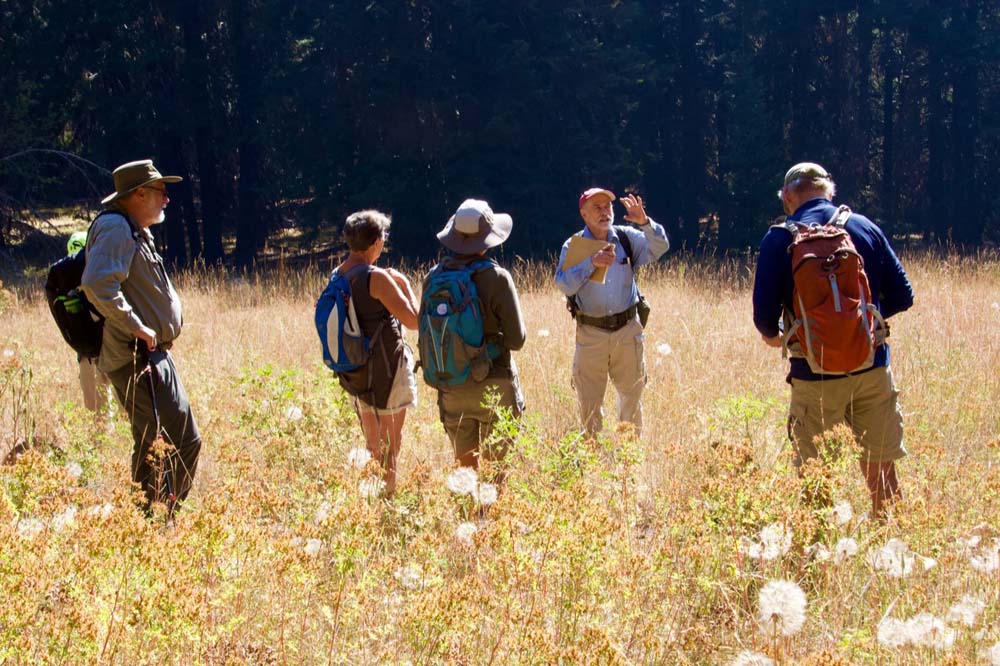
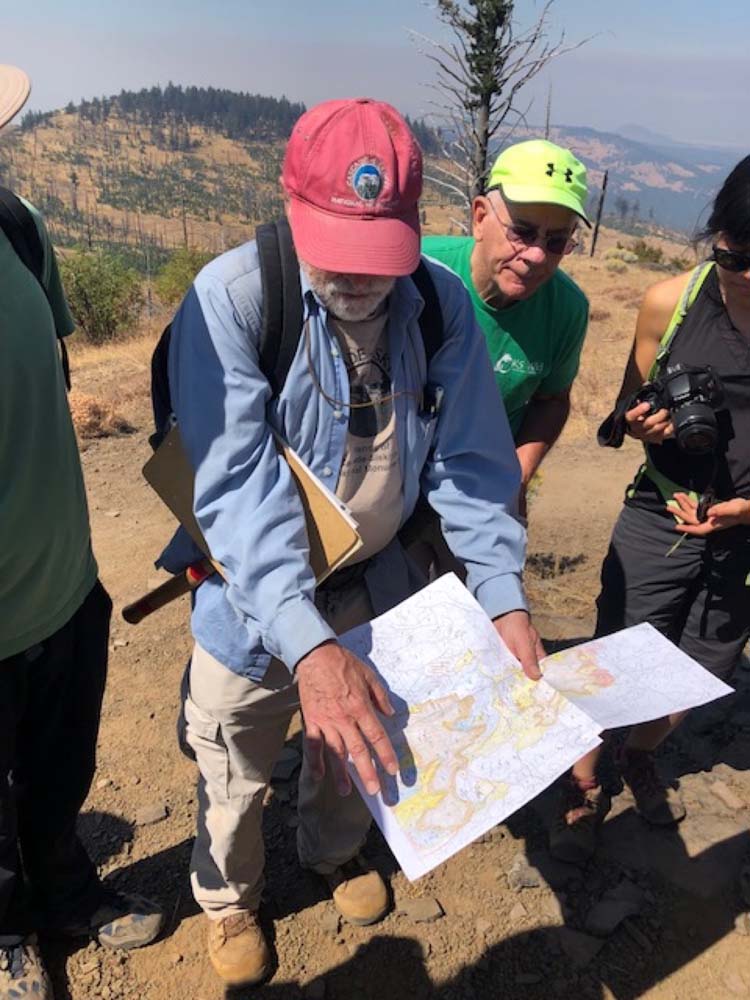
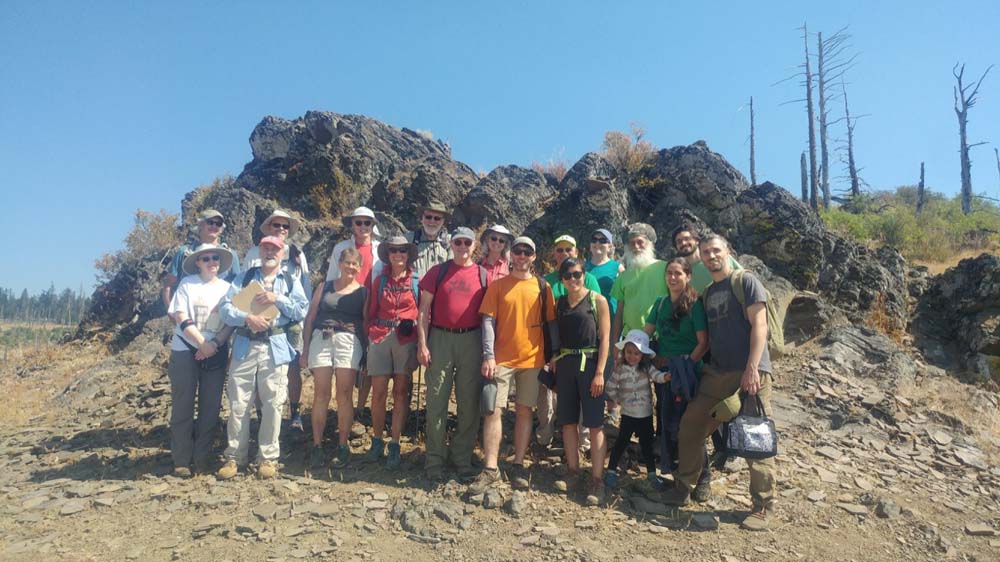
 Geologist Jad D’Allura, SOU professor emeritus (with red hat, right center), shows Hike and Learn group the summit of Grizzly Peak. Heather Wilson photo
Geologist Jad D’Allura, SOU professor emeritus (with red hat, right center), shows Hike and Learn group the summit of Grizzly Peak. Heather Wilson photo

The earth beneath our feet is full of stories just waiting to be told. On Saturday, September 8, a group of eager learners gathered to learn the geologic story of Grizzly Peak. Our guide was Southern Oregon’s resident geology guru, Jad D’Allura. Together, we would trace the history of this well-known landmark, included within the expanded boundary (2017) of Cascade-Siskiyou National Monument.

During a pre-hike talk the night before, Jad brought an audience of more than 70 attendees into the fold, introducing us to the jargon and processes that would help us interpret the geologic stories that surround us. We began by learning about the general characteristics of volcanoes before focusing on features unique to the Bear Creek Valley. Wrapping up the evening with a hands-on quiz (which everyone passed with flying colors), Jad had set the stage for a highly educational trek to the top of Grizzly Peak the following morning.

Our educational journey began even before we made it to the trailhead. We stopped several times on the way up Dead Indian Memorial and Shale City Road to observe signs of a tumultuous past. Across from a dacite quarry, we stopped to inspect large blocks of lava rock dotting a grassy field. These boulders were brought there long ago by a landslide that extends approximately five miles to the skyline ridge.

We stood at the base of this landslide looking up at Grizzly Peak, noticing bands of vegetation that were made possible by variations in the underlying substrate. The inclination of these bands hints at tilting of the rock units that has taken place since their formation. These clues from nature would be the first of many that we observed along our geologic expedition.

After unloading at the trailhead, we discovered more geologic clues almost immediately. Boulders both large and small are scattered all along the trail. When we stopped to observe one of the more impressive specimens, Jad offered some insight. First, we were encouraged to notice the positioning of the rock and how it appeared to have been dropped there on top of the landscape. Second, he directed our attention to the reddish hue of the rock due to the oxidation of iron. This suggests that the rock was exposed to air, perhaps at the edge of a volcanic vent. With these observations in mind, we were able to surmise that we were looking at chunks of bedrock hurled there as spatter during an eruption of Grizzly Peak many millions of years ago.

As we continued, the trail began to flatten out and vegetation became more scarce. Smoke in the distance dashed our chances of glimpsing Mt. McLoughlin, let alone Mt. Shasta or Crater Lake. This was no major hindrance, as our focus was firmly on the geologic features beneath our feet.

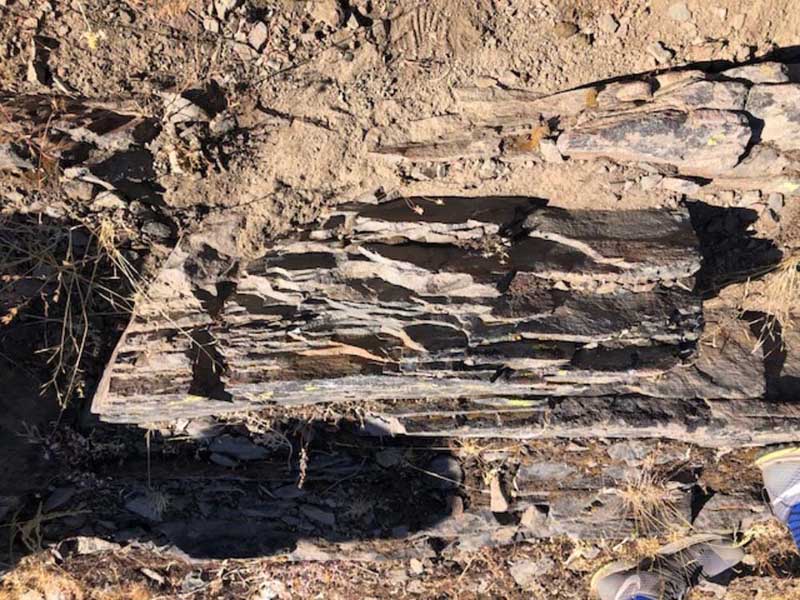
Atop the Grizzly Peak formation, we saw what looked like a more continuous lava flow rather than the spatter we had been seeing along the way. We also began to notice platy lava, or lava rock that cooled to form joints that look like flat stacks of dinner plates. Although these joints were parallel to each other, they were inclined about 15-20° to the northeast. This is due to the constant, slow uplift of the Klamath Mountains, a reminder that the landscapes we think we know are constantly under revision by the forces of tectonism.

On our way back to the trailhead, we stepped off trail to stand atop a subtle pile of boulders that marks the summit of Grizzly Peak at 5922 feet (without Jad to point it out, most of us would easily have missed it). As we victoriously summited these rocks, we still had questions swirling in our heads. Geologists have done wonders to shed light on how our landscape came to be, but there is still much that remains a mystery. As Jad says, the clues that geologists have at their disposal are much like a jigsaw puzzle bought at a garage sale – a lot of the pieces are missing and we may or may not even know what we are looking at. With patience and the guidance of a talented teacher, we can come to make sense of the stories that the earth has to tell.

by Heather Wilson, Hike and Learn Coordinator

Photos by Heather Wilson, except where noted.

The Land and Water Conservation Fund (LWCF)

Have you ever studied a map of Cascade-Siskiyou National Monument and noticed all the private land within the monument? This checkerboard of public land and private land makes management of this eco-rich area very complicated. And, by the end of this month a major change could make managing the checkerboard even more challenging.

Early in our monument’s history, the Bureau of Land Management (BLM) made it a priority to establish connectivity corridors by purchasing lands to fill in this checkerboard. The Land and Water Conservation Fund (LWCF) has been integral in helping fund acquisition of private land as it comes up for sale within the monument.  

The LWCF is a federal program funded from royalties paid by energy companies drilling for oil and gas on the Outer Continental Shelf. That money is then used for land conservation and park development. LWCF was established in 1964, and since then the fund has conserved more than seven-million acres across 40,000+ project sites.

Most people don’t realize the impact this fund has had on our communities, at no taxpayer expense. The list of landscapes that are in the public domain because of this fund goes on and on, including National Parks, national wildlife refuges, national forests, rivers, lakes, trails, and community parks in every single state.

For Cascade-Siskiyou National Monument the fund is vital to monument connectivity and safeguarding biodiversity. “To date, we have added a total of 12,607 acres to federal ownership in the CSNM through the LWCF,” informs Joel Brumm, BLM Assistant Monument Manager for Cascade-Siskiyou National Monument.

So, with all this in mind, we should all be very concerned about what is about to happen: the LWCF authorization is set to expire at the end of September. If Congress doesn’t act, this fund that is so vital to our communities in establishing recreation opportunities, clean water, and conserving landscapes for future generations will disappear.

Contact your House and Senate representatives today to tell them just how much you appreciate the landscapes and parks this fund has helped acquire, conserve, and protect, and urge them to not let the LWCF expire.

Contacts:
US Representative Greg Walden
US Senator Jeff Merkley
US Senator Ron Wyden

  This 2015 map shows land acquired (in green) through LWCF within the monument. Since then a 314-acre Mountcrest parcel located in the extreme NW portion of the CSNM on the West side of I-5 and an important 5-acre parcel along Keene Creek that is critical habitat for the federally-threatened Oregon Spotted Frog have been added.
This 2015 map shows land acquired (in green) through LWCF within the monument. Since then a 314-acre Mountcrest parcel located in the extreme NW portion of the CSNM on the West side of I-5 and an important 5-acre parcel along Keene Creek that is critical habitat for the federally-threatened Oregon Spotted Frog have been added.

Written by Shannon Browne
Community Partnerships Director
Friends of Cascade-Siskiyou National Monument. 

Through Smoke to the Monument

There is a saying, Per ardua ad astra, that translates to “Through adversity to the stars.” This summer I’ve developed my own personal version: “Through smoke to the Monument.”  

 Ranger Anna Kennedy tells about day hikes at the Cascade-Siskiyou National Monument Information Station. C. Beekman, BLM photo
Ranger Anna Kennedy tells about day hikes at the Cascade-Siskiyou National Monument Information Station. C. Beekman, BLM photo

Needless to say the early (and nearby) fire season has impacted my time with the Cascade-Siskiyou National Monument. For several weeks while the Klamathon Fire burned we had maps in the Contact Station and our back pockets outlining what portions of the Monument were closed for the public’s safety. When driving back down Highway 66 after a full day of hiking and talking with the public we would watch the dark plumes of smoke roll over the Siskiyous, often squinting to try and find Pilot Rock.  

When other fires began, filling the valleys with a gray haze, I wondered: Would visitors still come up to the Monument?  

The answer has been a resounding yes. Over the summer I’ve spoken with people from all across the country. Some sought to get out of the heat and find a shady spot by Little Hyatt Reservoir to dip their toes in. Many came to hike trails like the Greensprings Loop, or get a field guide to the wildflowers that lingered into July on Grizzly Peak. Others visited for an evening program on the beach and a Junior Explorer activity in the morning.  

In their own way, these people remind me of the resiliency of our forests. The fires are a natural part of this area and so are taken in stride. Our visitors seek out the clearer air and leave refreshed, ready to begin again, and our residents hold onto their roots, however young or old, here in the mountains. One way or another, like myself, they all have come through the smoke to the Monument.

by Paige Engelbrektsson
Interpretive Ranger Intern
Cascade-Siskiyou National Monument

Photos by Paige Engelbrektsson, except where noted.

Hike Recap: Bryophytes and Lichens

 Hike leader John Villella identifies macrolichens, such as  Letharia vulpina , a species of
Hike leader John Villella identifies macrolichens, such as Letharia vulpina , a species of “wolf lichen.”  E Thompson photo.

with John Villella, August 3-4, 2018

You may not know it, but you are surrounded by unsung heroes of the natural world. They inhabit twigs, trunks, rocks, soil, and even city sidewalks. Right beneath our feet, bryophytes and lichens are hard at work performing numerous ecosystem functions with little or no recognition at all. During our latest Hike & Learn, botanist and lichenologist John Villella helped us take a glimpse into the tiny world of these fascinating organisms.

On Friday August 3, John walked us through the basics of bryophyte and lichen biology. Bryophytes, including the liverworts, hornworts, and mosses, are spore-producing plants with no vascular tissue. More than 500 million years ago, bryophytes became the first plants to colonize land. Lichens are a bit more complicated. A lichen consists of a fungal partner and an algal partner living together in a mutually beneficial relationship. Essentially, the fungus provides a place for the algae to live and the algae provides “food” for the fungus through photosynthesis. Lichen can come in many shapes and colors, some subtle and hard to notice, others vibrant and other-worldly. A good rule of thumb: if it looks like it was made by Dr. Seuss, it is probably a lichen.

During our Saturday morning hike to Pilot Rock, we learned about the many ways that bryophytes and lichens benefit our ecosystem. When we see macrolichens such as the hairy-looking Usnea and Bryoria coating the branches of trees in the forest, it is easy to assume that the lichen is a parasite. It turns out that the exact opposite is true. Lichens do not steal nutrients from their substrates. Instead, their bodies absorb water from the air, creating a humid microclimate that helps trees obtain the moisture they need. When it rains, these lichens slow the flow of water down the trunk of the tree, which prevents soil erosion around the roots.

Mosses and lichens also provide habitat for microorganisms and invertebrates, which in turn form the base of a food web that supports larger organisms like birds and mammals. Moreover, lichens create habitat for plants on rocky substrates by breaking down rocks through the process of chemical weathering. Once larger plants are able to gain a foothold, their roots further break down the rock and slowly create soil.

One of the themes that emerged as we learned about lichens was their acute ability to survive. Lichens are not only incredibly long-lived (some are thousands of years old), but they can withstand incredible catastrophe. Wildfire, glacial events, and even the vacuum of space are no match for many lichens. These bizarre organisms can be found in every corner of the planet, even in the most desolate places. For instance, Antarctica, home to only 2 or 3 species of vascular plants, houses hundreds of species of bryophytes and lichens. These organisms are often the first to become established after environmental disturbances like fire or landslides, and pave the way for recolonization by other plants and animals.

As we arrived at the base of Pilot Rock and peered up into the smoke, we saw the rock formation in a whole new light. Pilot Rock is not only a popular landmark and a huge volcanic plug – it also habitat for dozens if not hundreds of species of lichens. Taking a closer look, we were scarcely able to find a single square inch of bare rock. Here, the lichens compete for real estate fiercely, if not extremely slowly. Who knows how many seasons they have seen, how many disasters they’ve endured, or how much longer it will take them to transform Pilot Rock into soil. These organisms, though small and easy to miss, hold the power to shape landscapes and form the foundation of ecosystems. Who knew all of that excitement was happening right beneath our feet!

by Heather Wilson
Hike and Learn Coordinator

Photos by Heather Wilson, except where noted.

Take A Closer Look with Ranger Ellie

 L to R: Interpretive Ranger Interns 2018 Anna Kennedy, Paige Engelbrektsson, and Ellie Thompson at CSNM Information Station.
L to R: Interpretive Ranger Interns 2018 Anna Kennedy, Paige Engelbrektsson, and Ellie Thompson at CSNM Information Station.

    What IS the Cascade-Siskiyou National Monument? What is special about this place? Why should we care about it? What should people know about it when they visit? Those were some of the questions that rolled around in my head as I drove up to the Hyatt Lake Campground on a warm June morning. I had just begun my summer internship at the Cascade-Siskiyou National Monument as an interpretive park ranger, and I had been tasked with coming up with an interpretive program for visitors at the campground. I knew I wanted my program to be fun and engaging, but I also wanted to leave my listeners with something to think about. I had spent hours poring over books and resources, searching for something that would help me explain the importance of the monument and the value of its incredible biodiversity, but I was coming up empty.     

Feeling slightly discouraged, I parked at the kiosk at the entrance for the Hyatt Lake Campground and hopped out of the rig. And then suddenly, there it was. My inspiration. The most beautiful moth I had ever seen—a Ceanothus Silk Moth (Hyalophora euryalus). I instantly stopped in my tracks and paused to marvel at its beauty up close.     

As an interpretive park ranger for the monument, I get a lot of visitors asking me questions like: “Where is the monument?” Or: “What is it?” It’s true that perhaps at first glance, the monument looks like just any other place in Southern Oregon. Yeah, there are mountains, and trees, and creeks, but so what? What’s the best way to communicate the importance of public lands, and this national monument in particular? Seeing that beautiful moth made me realize something. We can talk and talk about the meaning of biodiversity and the importance of protecting natural areas for hours, but the best way to build connections between people and nature is to engage their sense of wonder.

After having the privilege of being up on the monument almost every day for the past month and a half, I feel like I can begin to answer the question, “What is the monument?”. The monument is the beautiful Ceanothus Silk Moth. It’s the striking Striped Coralroot (Corallorhiza striata) orchid along the Pacific Crest Trail; getting its nutrients from fungi underground. It’s the Western Fence Lizard basking in the sun on a rock covered in five or more species of lichen, and it’s the calm and serene waters of Little Hyatt Reservoir. Sometimes you have to take a closer look to discover what makes a place special and unique.

As an interpretive park ranger for the Cascade-Siskiyou National Monument, it’s my job—no, my honor, to speak on behalf of this beautiful place and to encourage everyone I come across to take a closer look.

Come and check out our evening programs every Friday and Saturday night at 8pm until Labor Day, at Hyatt Lake Campground! Learn about the “Cascade Connections” by exploring the unique combinations of habitats and humans that meet here in the monument with Ranger Paige. Check out “Whooo Comes Out at Night?: Superheroes of the Cascade-Siskiyou National Monument” to learn about the diversity of owls that call the Cascade-Siskiyou National Monument home, and take a closer look at what makes owls so special with Ranger Anna. And learn the answer to the question, “Why So Many Butterflies?” Have you ever wondered why there are so many butterflies at CSNM? Learn about some of the special butterflies that can be found on the monument, and what brings them here, with Ranger Ellie.

And if you are passing through the monument in the morning, check out our Jr. Explorer Programs on Saturday and Sunday mornings from 10am-12pm. Participate in some fun activities, learn about the monument from a park ranger and receive your Jr. Explorer badge!

All of our programs are put on at the Day Use Area of the Hyatt Lake Campground. Our programs are FREE and open to the public!

By Ellie Thompson
Cascade-Siskiyou National Monument Interpretive Park Ranger

Photos by Ellie Thompson

Meet Our Rangers and Free Public Programs

All of our interpretive ranger programs take place at the Day Use Area of the Hyatt Lake Campground. Our programs are FREE and open to the public!
     Come and check out our evening programs every Friday and Saturday night at 8pm until Labor Day, at Hyatt Lake Campground! 
     Cascade Connections with Ranger Paige. Explore the unique combinations of habitats and humans that meet here in the monument. 
     Whooo Comes Out at Night: Superheroes with Ranger Anna.  Learn about the diversity of owls that call the Cascade-Siskiyou National Monument home, and take a closer look at what makes owls so special.
     Why So Many Butterflies? with Ranger Ellie. Learn about some of the special butterflies that can be found on the monument, and what brings them here.  

Jr. Explorer Programs are presented on Saturday and Sunday mornings from 10am-12pm. Participate in some fun activities and learn about the monument from an interpretive ranger and receive your Jr. Explorer badge!
 

MEET OUR RANGER INTERNS

 Interpretive Ranger interns Page Engelbrektsson, Anna Kennedy and Ellie Thompson at Cascade-Siskiyou National Monument. 2018 Photo by C Beekman
Interpretive Ranger interns Page Engelbrektsson, Anna Kennedy and Ellie Thompson at Cascade-Siskiyou National Monument. 2018 Photo by C Beekman

Our interpretive ranger interns at Cascade-Siskiyou National Monument are Paige Engelbrektsson, Anna Kennedy, Ellie Thompson. They are graduate students in Environmental Education at Southern Oregon University.     
     They are inspired by the monument’s biodiversity and wilderness and looking forward to share this special place with people of all ages–to care about nature and our public lands.

Paige Engelbrektsson, a Virginia native who grew up finding the wonder in the wild places around her suburban neighborhood and childhood barn. After graduating with a B.S. in Biology from the College of William and Mary, she was elbow-deep in assisting museum researchers when she discovered two things. One, teaching visitors about the new and intriguing natural history facts she uncovered offered its own kind of wonder. Two, there was an entire country full of awe-inspiring, truly wild spaces she could live and teach in. So began a cross-country trip that has lasted four years and counting. From guiding backcountry pack trips in Yellowstone National Park to teaching outdoor afterschool programs as an AmeriCorps member in North Carolina, Paige’s pursuit of sharing the wonder of the natural world has led her through a checklist of mountain ranges and ultimately to Southern Oregon.

Anna Kennedy grew up in a small town in Northern California, surrounded by redwoods, the Russian River, and a wild backyard full of endless possibilities. Whether hiking along the coast, camping in the redwoods, or building tree-forts, she found tranquility, inspiration, and a fascination for life in the great outdoors. This early love and curiosity led her Anna to pursue a degree from UC Davis in Wildlife, Fish, and Conservation Biology. Over the summers, Anna worked as a Trips Guide at Skylake Yosemite Camp, leading kids on day and multiday backpacking adventures in the Sierras. Her longing to be outside and learn everything about the natural world evolved into a desire to help educate and engage children outdoors. After graduation, Anna continued to work with youth as a Montessori Assistant Teacher and as a summer Camp Director.

Ellie Thompson developed her love for nature and the outdoors at a very young age. As soon as she could walk, she began exploring the family farm in Eugene, Oregon and the ponds behind her house—collecting flowers, insects, and minnows to observe and marvel at. Her family vacations consisted of camping and hiking all over Oregon, spending days kayaking the remote Owyhee River, and visiting many natural history museums; learning about the land and its native flora and fauna. Her inquisitive mind and passion for learning about the world around her drove her to pursue a degree in biology at Portland State University. While she loved her major, she wasn’t sure what career to pursue after college. It wasn’t until she stood on the banks of the Kinabatangan River, in Malaysian Borneo, that she realized what she wanted to do. Witnessing the devastation of one of the oldest tropical rainforests in the world was a powerful experience that ignited passion for conservation and education in her.

Come by and say hello! 

A Land For All Seasons 

A photo essay by Matt Witt about the Cascade-Siskiyou National Monument is featured in an 8-page color spread in the annual arts issue of Southern Oregon Magazine.
     Matt, a 2017 Artist-in-Residence, shares his images of the Monument on our newsletter and shows us all the many reasons to champion our public land. 


 Howard Hunter, Friends of CSNM Advocacy Chair at 4th of July booth. Photo by Ellie Thompson
Howard Hunter, Friends of CSNM Advocacy Chair at 4th of July booth. Photo by Ellie Thompson

Thank you for your support at the The 4th of July Celebration in Ashland, OR!
Friends of CSNM and our interpretive ranger interns enjoyed meeting everyone who stopped by our booth in support of our monument and public lands!  During this 18th anniversary, we enjoyed sharing about the biodiversity and wonders of the Cascade-Siskiyou National Monument. 


Recap: Wildflower Walk & Wine Tasting

With Naturalist Jeanine Moy, June 10, 2018

 Naturalist Jeanine Moy identifies sun-loving lithophytes.
Naturalist Jeanine Moy identifies sun-loving lithophytes.

On the brink of summer, a trip up a mountain can mean a trip back in time. Many flowers that have bloomed and gone to fruit on the valley floor are still in full glory above 5,000 feet. This was the case for our Wildflower Walk & Wine Tasting event on June 10. As we unloaded at the Grizzly Peak trailhead it was as if we’d travelled back to April again. We knew we were in for a great day of botanizing.
    As expected, the trail was lined with interesting and beautiful native wildflowers. Our expert guide, Jeanine Moy, helped us to put all of these species into context by sharing useful natural history information along the way. We were all excited to find some very healthy striped coralroot (Corallorhiza striata), an orchid that gets its energy from mycorrhizal fungi instead of photosynthesis. Another interesting sighting was the western trillium (Trillium ovatum) whose petals had turned dark pink and nearly translucent. These flowers fade from bright white to deep pink as they mature, seemingly signaling to pollinators that their services are no longer required.
    Jeanine also shared ethnobotanical information about the species we found. From the potent, spicy root of the wild ginger (Asarum caudatum) to the edible camas bulb (Camassia quamash) to the yellow pine pollen that coated the trail, it seemed that we were surrounded by plants with nutritional value. Many plants hold medicinal value as well, such as the Lomatium whose root produces a latex that has antibacterial properties.
    The forested scenery quickly changed as we made our way toward the scenic vistas at the far reaches of the Grizzly Peak trail. Grizzly Peak is in the recently expanded portion of Cascade-Siskiyou National Monument and encompasses an area that burned in the Antelope Fire of 2002. As we looked out over the landscape, we saw the life that had returned in the 16 years since the fire punctuated by the burnt snags that stood like statues. A lush carpet with patches of larkspur, fiddleneck, seablush, paintbrush and more covered the area that was barren not long ago. The stark contrast between the blackened fire-scarred trees and the pastel rainbow of wildflowers told a story of rebirth.
    As we made our way back down the trail, we were sad to leave the cool, calm forest, but we were looking forward to our next destination – wine tasting! We headed back to civilization with our sights set on Belle Fiore Winery. We kicked some of the dirt off of our boots before finding a seat on the patio. The manicured lawn wasn’t quite as interesting as Grizzly Peak, but we had botany bingo to keep our minds active. Soon, the table was full of flights of wine, which we sampled and savored with delight. As the wine slowly disappeared, we reflected on what a wonderful day it had been. Wildflowers, wine, and great company on a gorgeous day – what more could you want?

Photos and text by
Heather Wilson
Hike and Learn Coordinator