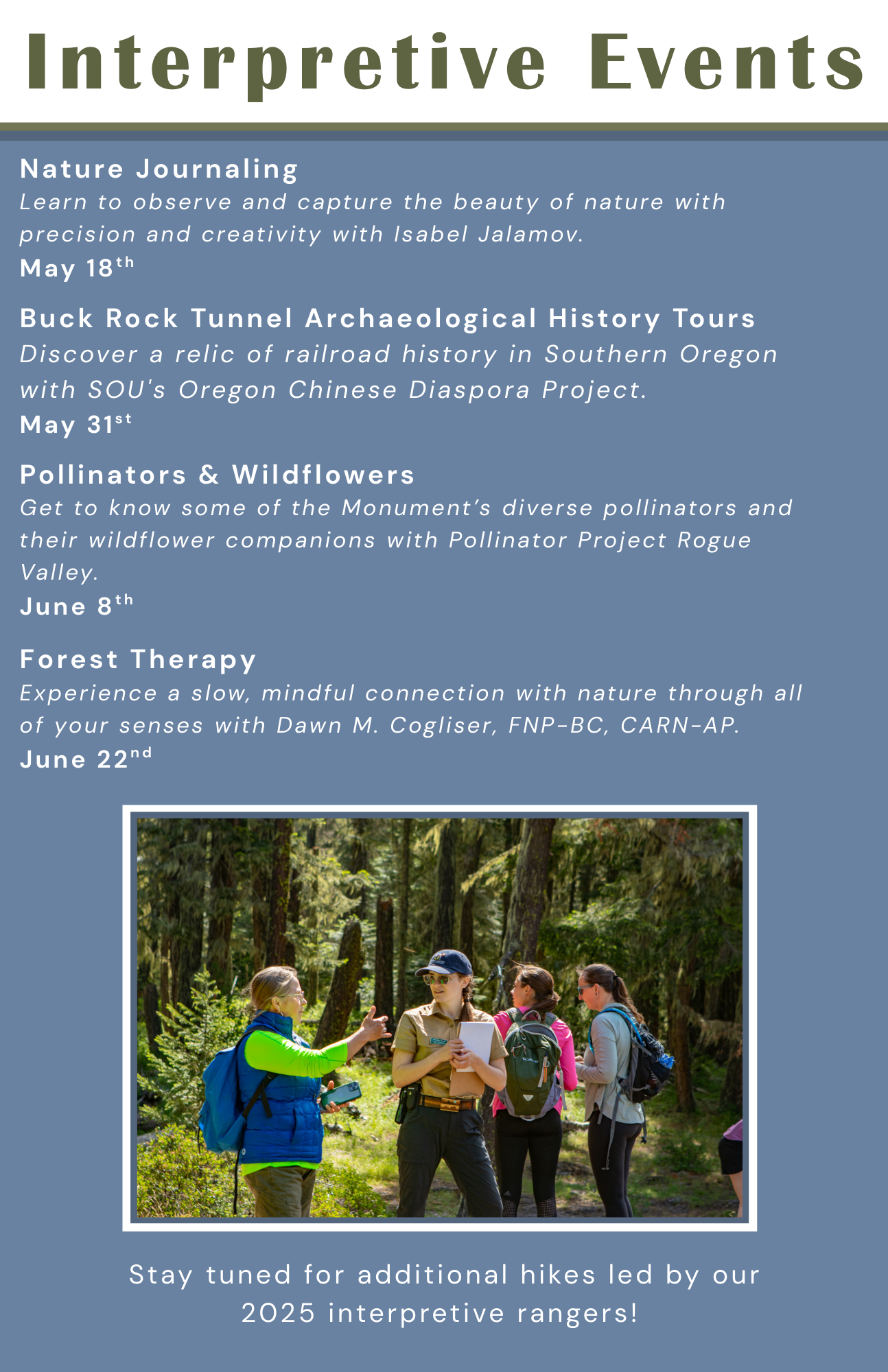
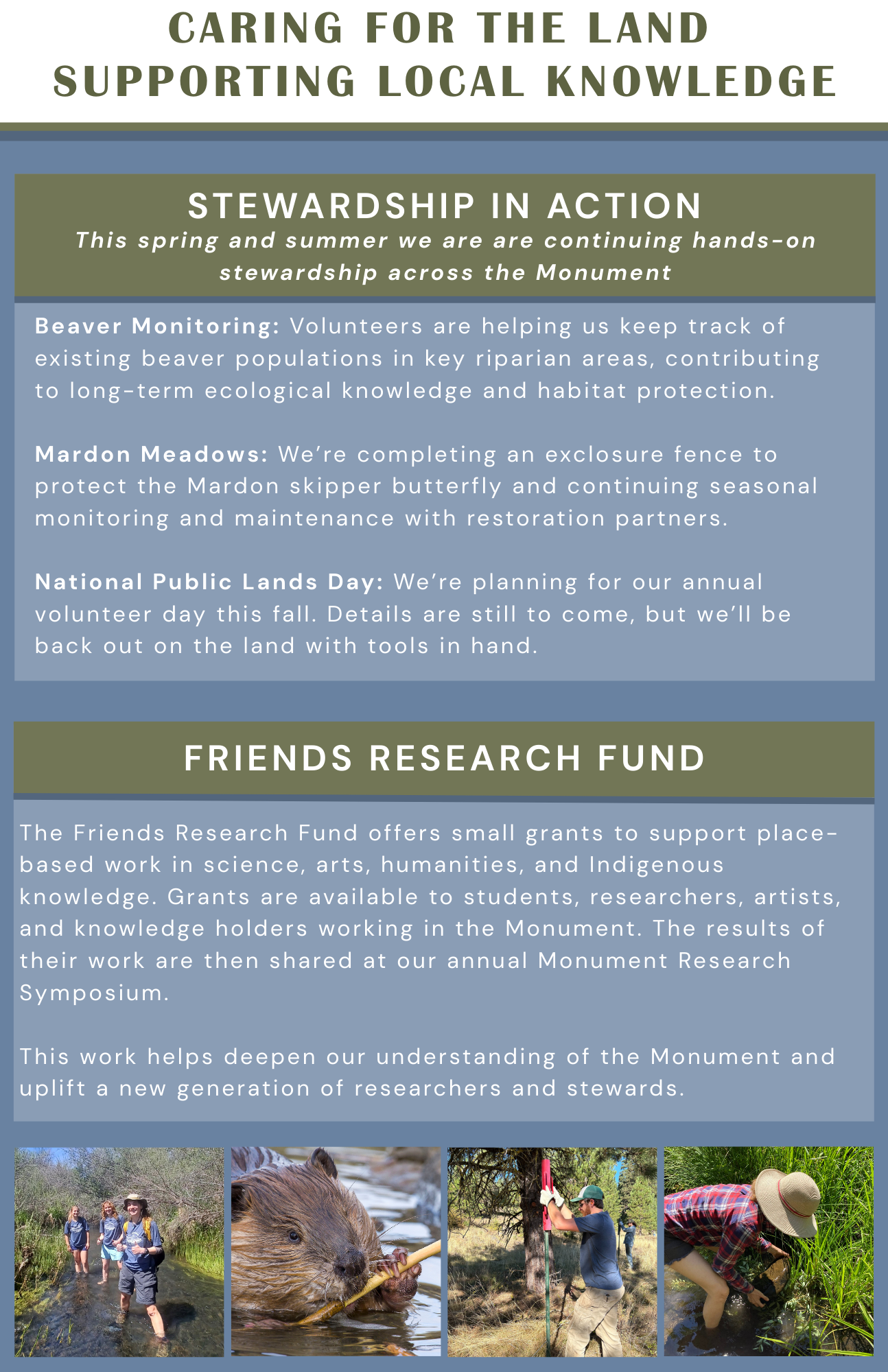
Last week we were fortunate to gather with a close group of supporters, staff, and volunteers to kick off our 2025 end of the year fundraising campaign and to celebrate the meaningful work we accomplished this year. It was a reminder of how much this community makes possible and how much energy there is behind protecting the biodiversity and richness of the Cascade-Siskiyou National Monument.
This summer marked the fourth year of Monument Days, a partnership between Friends of Cascade-Siskiyou National Monument and The Crest, made possible with generous support from the Gray Family Foundation, which helps sustain youth education programs. Every Wednesday campers from The Crest’s Summer Nature Day Camp joined our interpretive rangers on excursions in the Monument to connect with its immense biodiversity. Since its start, the program has connected hundreds of children with the Monument. This year, 214 young learners participated in hikes, games, and creative activities designed to spark curiosity and connection with the natural world.
Reflections from Ranger Emma
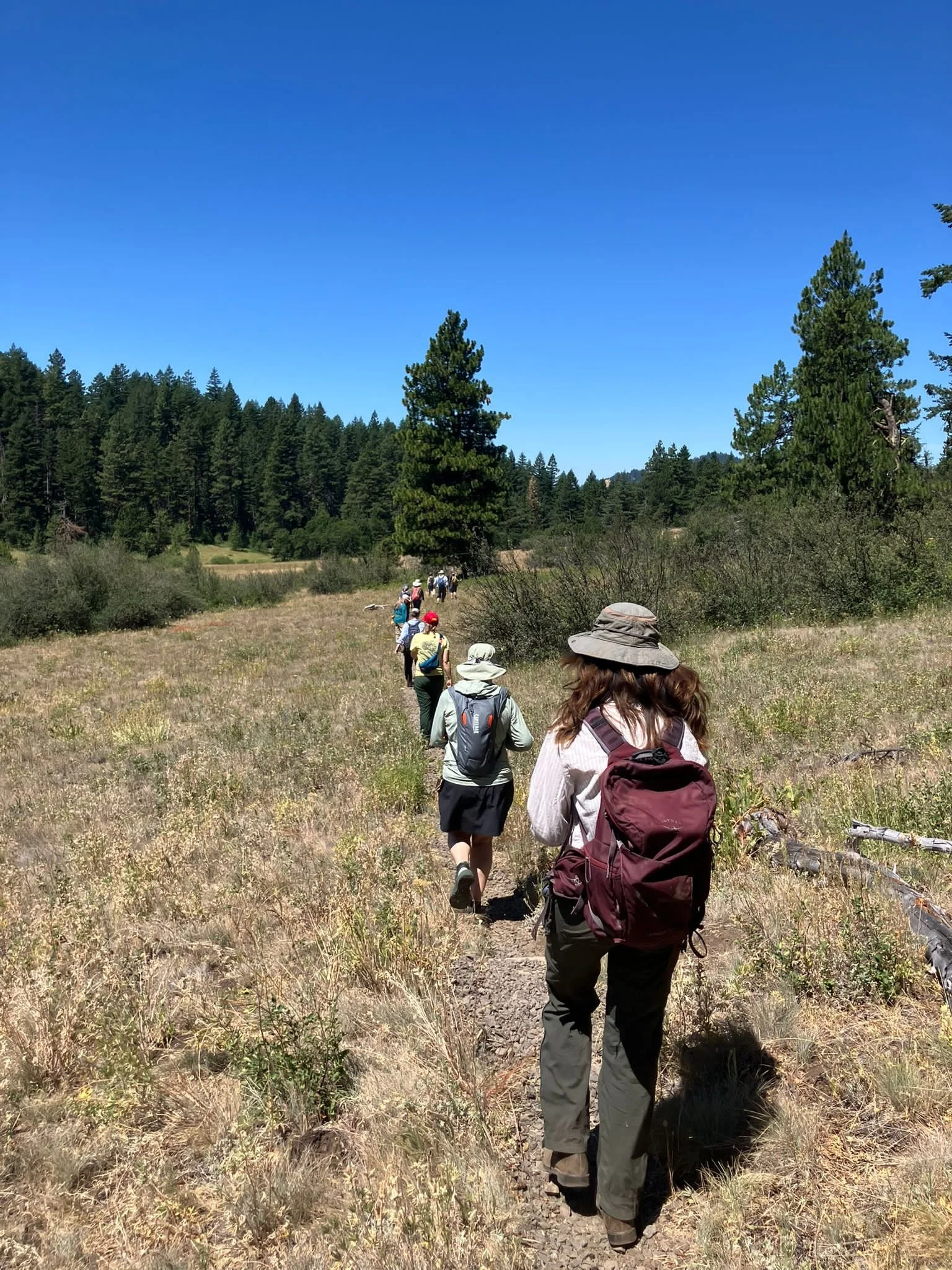
Campers ages six to eleven were led through conifer forests and oak grasslands along the Green Springs Mountain Loop Trail. They shook the hands, or should I say the needles, of white firs, Douglas firs, and ponderosa pines, and learned that the difference between white and black oak is the shape of their leaves’ lobes.
Games involving echolocation and hawk-like eyesight were played throughout the hike, giving campers a new perspective on how wildlife navigates the world and helping to build up an appetite. Lunch came with a sweeping view of the Rogue Valley, where we identified Mt. Ashland, Pilot Rock, and the soon-to-be wildlife corridor across I-5. This time was also used for solitude, nature journaling, and, whenever possible, lizard hunting.
Walks back were often quieter than the way out, but the discovery of wild strawberries, thimbleberry, and miner’s lettuce along the trail always brought smiles. Back at our base camp, the afternoons were filled with storytelling, fort building, and lots of watermelon.
Thanks to everyone who made Monument Days 2025 possible. With each passing year, the program continues to grow, inspiring the next generation of stewards for this incredible place. We are especially grateful to our partners at The Crest and to the Gray Family Foundation for making this program possible
Campers explore the meadow along the Greensprings Loop Trail
On Sunday July 27th, a group of about 15 participants joined Interpretative Rangers, Jay (the writer of this post) and Emma for an ethnobotany hike. The group hiked along the PCT from Little Hyatt Lake, south towards Hyatt Meadows. Along the way we encountered a variety of plant communities, including riparian meadow, mixed conifer forest, oak savannah, and dry meadow. Along the trail we made various stops to discuss ethnobotany, and I am going to share some of them in this post with you today! First, we will give an overview of indigenous removal from these lands, and why many ethnobotany traditions aren’t widely practiced today. Then we will dive into uses of camas and yampa for food, and beargrass and hazel for basketry, followed by discussion on how fire is used to manage landscapes where these plants grow. Lastly we will offer a species list of the plants that we explored on the hike, and some additional resources for finding more information!
Hikers gather with interpretative ranger Jay Ryan sharing indigenous history in the CSNM – PC: Rianna Shiree
Ethnobotany is the study of how indigenous people use plants for cultural purposes, such as food, medicine, basketry, ceremony, and more. Indigenous people have been living in Oregon since time immemorial and using plants for cultural purposes. What we call the Cascade-Siskiyou National Monument is within ancestral territories of the Takelma, Latgawa, Shasta, Klamath, Modoc, and other peoples, all of whom had various ethnobotanical practices. Unfortunately, many of these ethnobotany practices, among other cultural practices such as languages and customs were stolen and criminalized through assimilation and genocide.
Following settler colonialism – to a large extent the gold rush – these groups were forcibly removed from their lands and/or restricted from cultural practices. Due to competition for various resources, such as water, land, and food, settlers drove out native people. Environmental disturbances from livestock and pollution also had significant impacts. For example, Takelma peoples’ camas meadows were destroyed by an abundance of livestock hogs that would dig up the camas bulbs (more on camas later), and Shasta peoples’ salmon fisheries were damaged by effluence from gold mining. Takelma, Latgawa and Shasta people were removed to the Siletz and Grand Rhonde reservations on the coast in NW Oregon. Now the living descendents of the Shasta, Takelma, and Latgawa peoples are members of the Confederated Tribes of the Grande Ronde Indians and Confederated Tribes of the Siletz Indians. The Klamath and Modoc people were removed from their lands and placed on a reservation in the Upper Klamath Basin, which was economically successful through ranching and timber industries, but lost their federal recognition as a tribe and therefore lost their reservation.
Because these indigenous groups had no written language, through this tragic history of forced removal, assimilation, and outlawing of cultural practices, much of their ancestral knowledge was stolen from them. Despite this, the knowledge and practice of many traditions remain strong today, including ethnobotanic practices.
First Foods: Camas and Yampah
Our first stop was in a riparian meadow adjacent to Keene Creek, downstream of the dam at Little Hyatt Reservoir. Here we found remnants of camas seed pods, and discussed first foods. Foods are means of nutrition as well as a way of life for indigenous people. While plants like camas (Camissia) and yampah (Perideridia) have historically grown abundantly, meadows containing these plants are managed to produce higher yields of foods.
Camas and Yampa are examples of geophytes, or plants that have an underground storage vessel. These are perennial plants that spend the growing season pumping nutrients into these vessels for overwintering. Then, when spring arrives and temperatures warm, the plants have the food they need to put up leaves and flowers right away. We can find many geophytes in the grocery store such as potatoes, carrots, or onions, or in our gardens such as tulips or daffodils. Geophytes come in a variety of forms such as corms (garlic), roots (carrots), bulbs (onions), tubers (potatoes), and rhizomes (ginger).
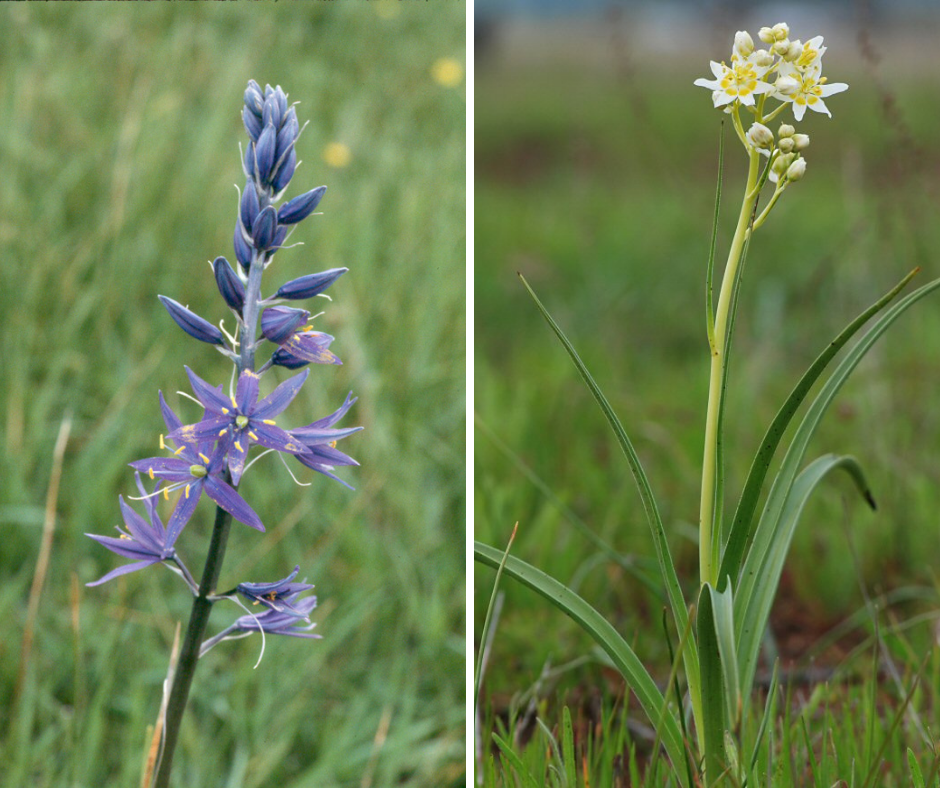
Left: Camassia quamash (great camas) – PC: Steve Thorstead. Right: Toxicoscordion exaltatum (death camas) – PC: Barry Breckling.
Camas, known by many as “indian potatoes” is a starchy tuber with a brilliant blue and purple flower. While a different family entirely, camas tubers and leaves resemble those of death camas (Toxicoscordion exaltatum), which is highly toxic, as the name suggests. When gathering, people wait until the plant has gone into full flower, as the flowers of the plant are distinguishable. Joe Scott, a member of the Confederated Tribe of the Siletz Indians, runs the Traditional Knowledge Inquiry Program (TEIP), and is featured in a Buffalo’s Fire article about camas preparation. In this article, they describe how camas is prepared, first by removing outer papery leaves, then baking in an earthen oven for 1 – 4 days! This converts ⅓ of the starchy mass to tasty fructose. Still, many settler’s accounts of eating camas, like those of Lewis and Clark, have ended in stomachaches and restless nights. While traditional methods are still practiced today, camas is often cooked for several days in a slow cooker.
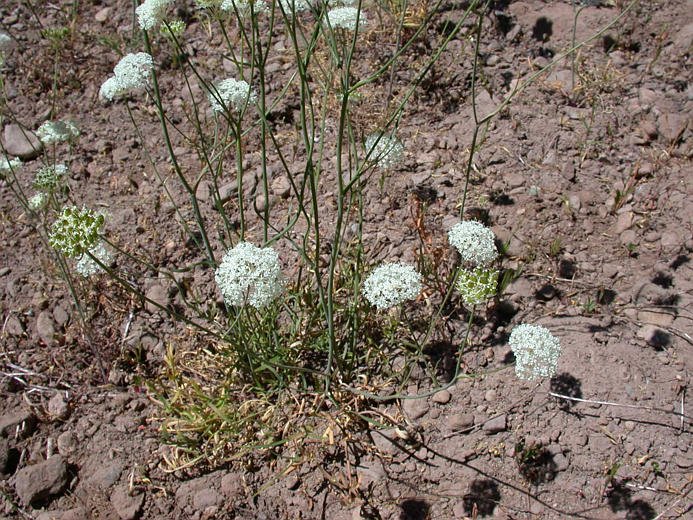
Periderida bolanderi (yampah) – PC: Gary Monroe
Later in the hike, around lunchtime, we visited a dryer meadow, known as Hyatt Meadows, where another first food, yampah, grows abundantly. Yampah is also a geophyte, this one in the carrot family, Apiaceae. In 2019 the Siletz Tribal Youth Development and Healty Traditions program visited nearby Vesper Meadow to reconnect with tribal traditions, and described their relationship with yampah, a name that comes from the Paiute word ya-pah for “water is here.” Just like carrots, yampah roots are eaten roasted, boiled, raw, or dried. The roots have medicinal use too! An infusion (tea) made from the roots is used to wash sores and wounds and clear mucus. A poultice of roots reduces inflammation, and a poultice of seeds can treat bruises. Chewing on the roots can ease sore throats and coughs. Yampah is harvested during dormant season and stored in sand at a cool 38˚F. According to Mt. Pisga Arboretum, it is harvested in late spring or early summer when the soil is soft. The roots are cleaned at digging sites to ensure rootlets return to the soil. Seeds are also left behind, in hopes that they will germinate. Additionally, to help the plants grow, yampah tenders pull competing species out of the way when digging, and seeds are scattered on the ground during ceremony.
Weaving: Beargrass and Hazel
Midway on the hike we passed through a dense conifer forest, primarily composed of Douglas-fir trees. In the understory, beargrass (Xerophyllum tenax) grows abundantly. Beargrass is a common plant used for weaving baskets that is widespread in North America, and is even traded for outside of its native region. The US Forest Service put out a great report about beargrass, titled Natural and Cultural History of Beargrass. Beargrass’ strong and flexible material makes it good for weaving, but baskets aren’t just for holding things. Basketry is “a sacred practice that is important to maintaining the role of certain entities in our lives and recording our History,” said CHiXapkaid, Skokomish Traditional Bearer of Southern Puget Salish Culture and Professor at Washington State University. Basketry and baskets carry the identities of the families who weave them. Beargrass is also used for regalia in ceremony, but the use of this is less widespread, fairly local to Northern California and Southern Oregon indigenous people. There is an excellent video of how beargrass regalia is used, however the presenter is unnamed (you can see my comment hoping to find the creator). Klamath mountain peoples make braids to hang from dresses and necklaces, to make men’s quivers and aprons, and it is stuffed in headrolls. Additionally beargrass gets wrapped around leather strips with berries and shells attached. These make a lovely shaking sound when worn by a dancer.
Left: Xerophyllum tenax (beargrass) in flower – PC: Keir Morse. Right: beargrass basket – PC: Frank Lake.
The abovementioned report on beargrass describes harvest practices as well. Beargrass is best harvested following snowmelt in late spring early summer, with preference for high elevation and low shade leaves, as they are less brittle and more pliable. 3-7 years after wildfire or cultural fire is an ideal time to harvest. Cultural burning promotes rigor and growth of beargrass. Gatherers have a preference for longer, thinner, more pliable leaves that are whitish at the base. Only the longest leaves from mature plants are selected, to keep the plant in good health for subsequent years. Following harvest, leaves are cured in the sun for 1-3 days. Letting them dry for too long will leave them dry and brittle. Often beargrass is dyed with wolf lichen, oregon grape, and other natural dyes, but with modern things as well, such as Koolaid!
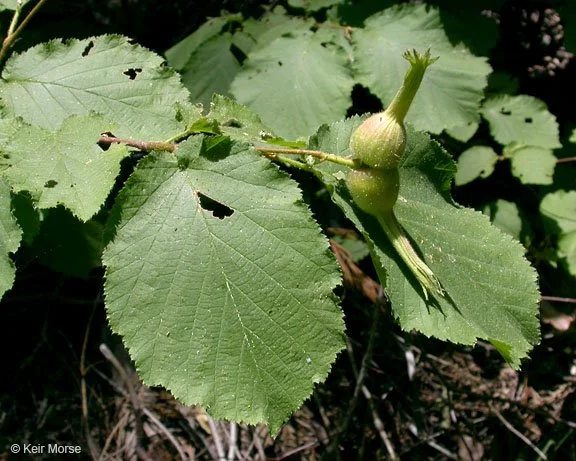
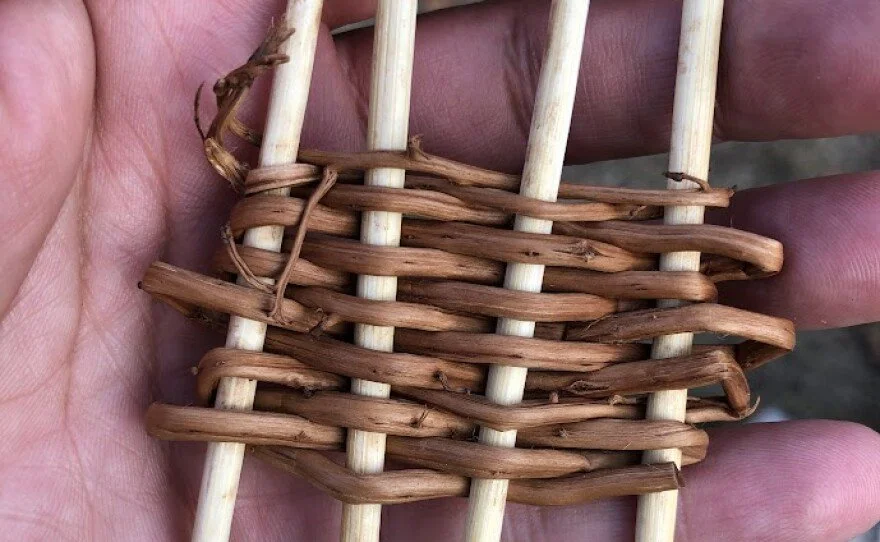
While we didn’t see any on the hike, Hazel (Corylus cornuta) is another plant that is used for basketry, as well as food! Hazelnuts are widely consumed and tasty when roasted. Hazel sticks are great for basketry, as they are flexible and rigid. Similar to beargrass, hazel responds well to fire. News outlet KLLC out of Eugene reports on how the TEIP uses fire to manage hazel, interviewing father and son Drew and Jerome Viles. In many places, cultural burning or broadcast fire on the landscape is not possible, because it has been outlawed and/or puts homes at risk. Jerome says, “Hazel has evolved with fire. When burned, plants sent up long, straight shoots.” His father, Drew says that “Hazel likes to be coppiced, or cut, it puts up good shoots after it’s been coppiced. Good sticks come two years after burning.”
Corylus cornuta (hazel) – PC: Keir MorseBeginning of a hazel basket – PC: Bill Barr, KLLC
The aforementioned plants: camas, yampah, beargrass and hazel, have all been managed by cultural burning for millennia. Many camas and yampah meadows were formed during glaciation, and periodically were burned to keep them open and free from conifers. Similarly, beargrass and hazel rely on burning to put up fresh leaves or stalks. When indigenous people were forcibly removed from the landscapes, cultural burning was outlawed, and a paradigm of fire suppression existed in our forests, these plants suffered from a loss of these ecological forces they relied upon for growth. Today, cultural groups such as TEIP, Lomakatsi Restoration Project, Cultural Fire Management Council, and the Rogue Valley Prescribed Burn Association work in the Klamath, Siskiyou, and Cascade mountains to advocate for and implement cultural burning, prescribed burning, and fire mimicry. We encourage you to visit these sites and advocate for a return of fire for cultural and ecological purposes.
These four plants were just a few plants that we discussed on the hike, for a complete species list, see below!
For more information on ethnobotany and indigenous land management, see the following sources that I consulted for my research on this walk!
BRIT Ethnobotanical Database – a website where you can search for any plant and see documented ethnobotanical uses.
Iwígara – a book describing cultural uses of various plants across North America
Tending the Wild – a book discussing native american land management in California
And feel free to make a google search about any plant you’re interested in. Unfortunately knowledge of many cultural uses have been stolen and were never recorded on paper when indigenous people were outlawed from speaking their native tongue. However, there is a lot of information out there, and I encourage you to go look for it!
At the end of the day, the participants walked away with a head full of knowledge and fresh perspectives about the landscapes they reside on and around.
Hikers return to the trailhead, contemplating the vast uses for our native plants. – PC: Rianna Shiree.
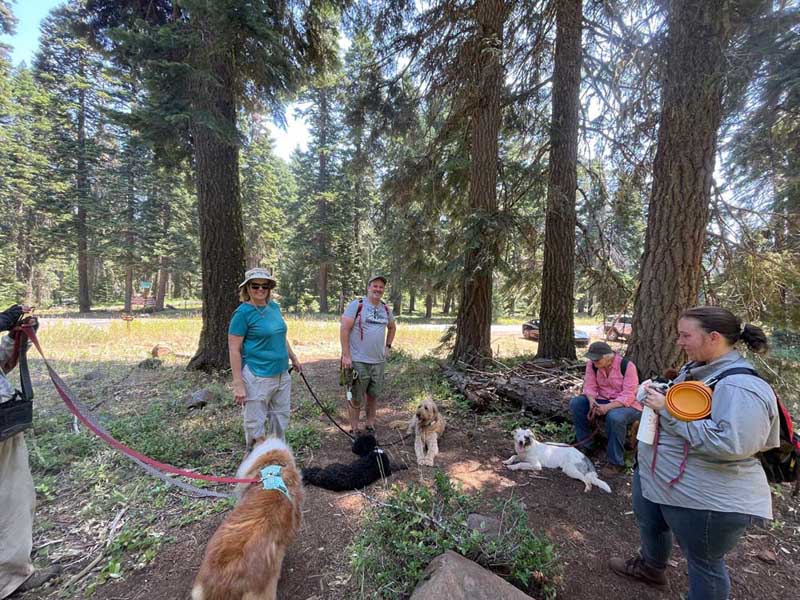
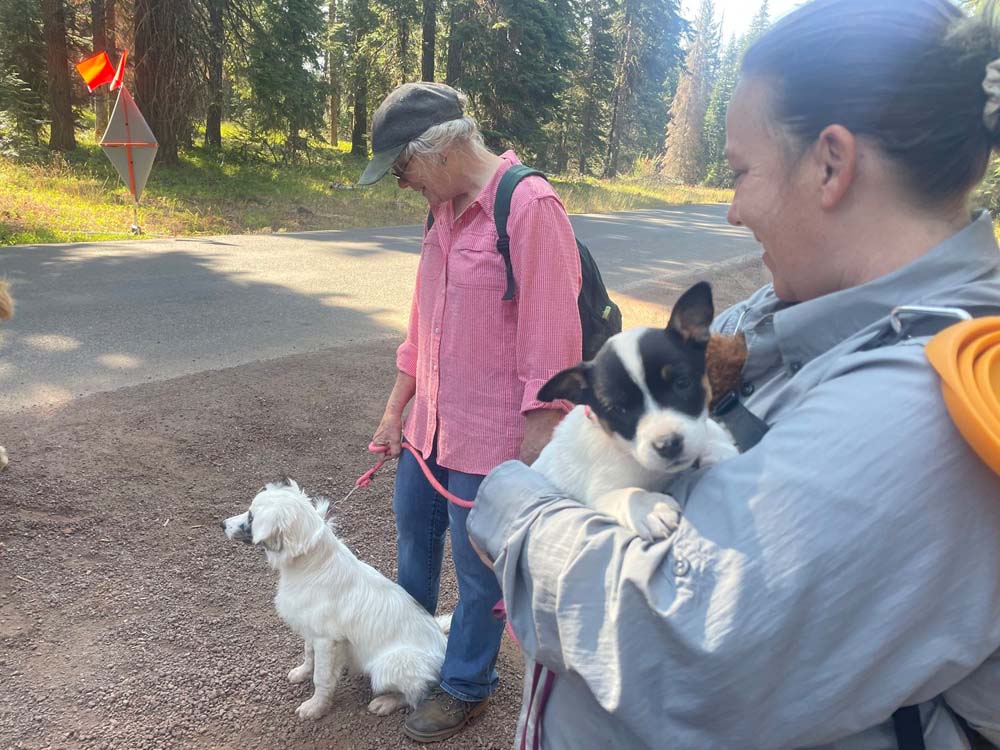
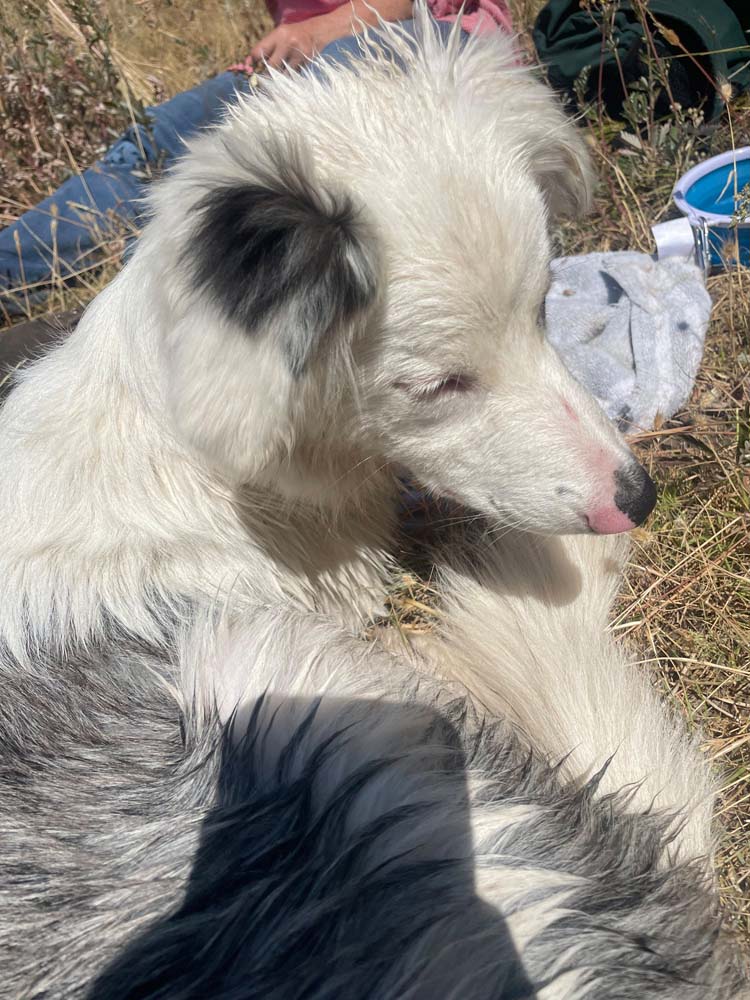
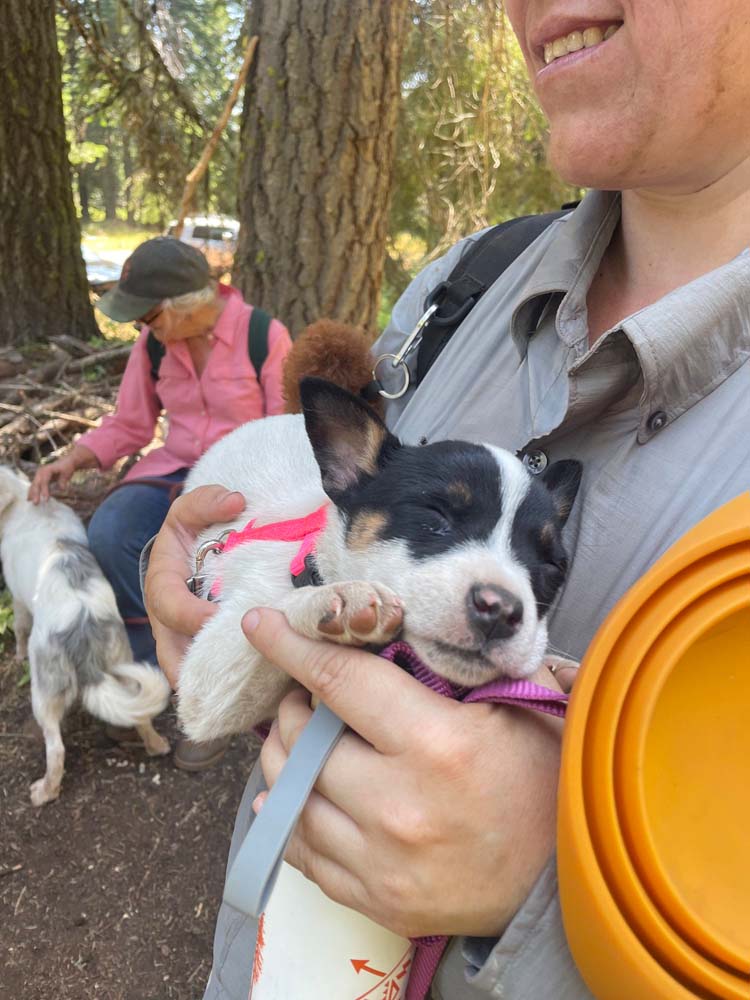
Dogs are great! They make wonderful companions and hiking buddies, but it’s important to have some guidelines to help all have a safe, fun adventure. On Sunday, July 28th, Friends of Cascade-Siskiyou National Monument embarked on a special, dog-friendly hike.
In the Monument, summer wildlife abounded, including pollinators, resilient wildflowers, and energetic songbirds. We even ran across other animals enjoying the trail with their humans when we met some horses! Our hike along the PCT to Little Hyatt Lake culminated in some fun water-time for the pups to cool off, in a designated swimming area or course.
Rangers Nora and Emily went over Leave-No-Trace Principles from the Center of Outdoor Ethics (lnt.org) and applied those same ideas into a set of guidelines for dog and nature enthusiasts in the Monument. Below is what our group came up with, through conversation and in following Leave-No-Trace principles from the Center for Outdoor Ethics (lnt.org). Can you think of any other suggestions?
We also discussed some possible interactions to avoid while hiking with your dog. As safety is our priority, we discussed some native plants we were sure to encounter that can be toxic to pets, such as the Oregon Grape. Mindful enjoyment and appreciation of the natural world is something we at FCSNM strongly encourage, while remembering that sharing is caring, and time and place are everything!
Have you ever captured the essence of a flower in your sketchbook or recorded the dance of a butterfly in the margins of your journal? Last week, I had the pleasure of leading a nature journaling workshop at the Green Springs Mountain Loop Trail in the breathtaking CSNM, where a group of eager participants and I immersed ourselves in the natural beauty of this unique landscape.
Planning this workshop was an adventure in itself. The Cascade-Siskiyou National Monument, with its rich biodiversity and stunning vistas, was the perfect setting. I gathered all the necessary materials: sketchbooks, pencils, and field guides, and prepared a series of activities designed to engage both beginners and experienced journalers.
We began our day by spending some time orienting to the space and priming our brains to be mindful and observant throughout the day. Then, we dove into the art of nature journaling. We discussed the basics of the practice, its benefits, and practical tips for getting started. Our group, a mix of solo explorers and seasoned journalers, eagerly dived into the initial exercises. We started with simple observational sketches of nearby plants, rocks, and other things that caught our eyes, focusing on making meaningful observations.
After hiking a short stretch of the trail, we did an activity called “My Secret Plant”. Participants had to test their observation skills by creating an accurate journal entry which captures the essence of the plant they chose, in such a way that someone with no frame of reference could pick out the plant out of a small group of samples.
Lunch provided a welcome break and an opportunity for participants to relax, eat, and socialize. Many took this time to share their morning journal entries and continue looking for nature’s treasures, fostering a sense of community and mutual appreciation for each other’s work.
The afternoon brought with it a continued fervor to explore and note observations of interest. The first activity of the afternoon, known as “Zoom In, Zoom Out”, allowed us to think about and discuss the concept of scale. It was during this time I found that participants really began to form strong connections with the natural items they chose, and getting to know them on a deeper, almost personal level.
Our day came to a close with one final journaling activity. Participants chose to create field guides in their journals, classifying different species of lichen based on visual and tactile observations. The depth of observation and reflection in these entries was impressive.
As we wrapped up the session, we collected feedback from participants and provided information on further resources and potential future sessions. The positive feedback and expressions of gratitude were heartwarming. It was clear that this experience had made an impact on everyone involved. I am grateful to all the participants for their enthusiasm, creativity, and willingness to connect deeply with nature. This session was a beautiful reminder of the power of nature journaling to inspire, educate, and bring people together. It is my hope to continue to be involved in programs like this in the future.
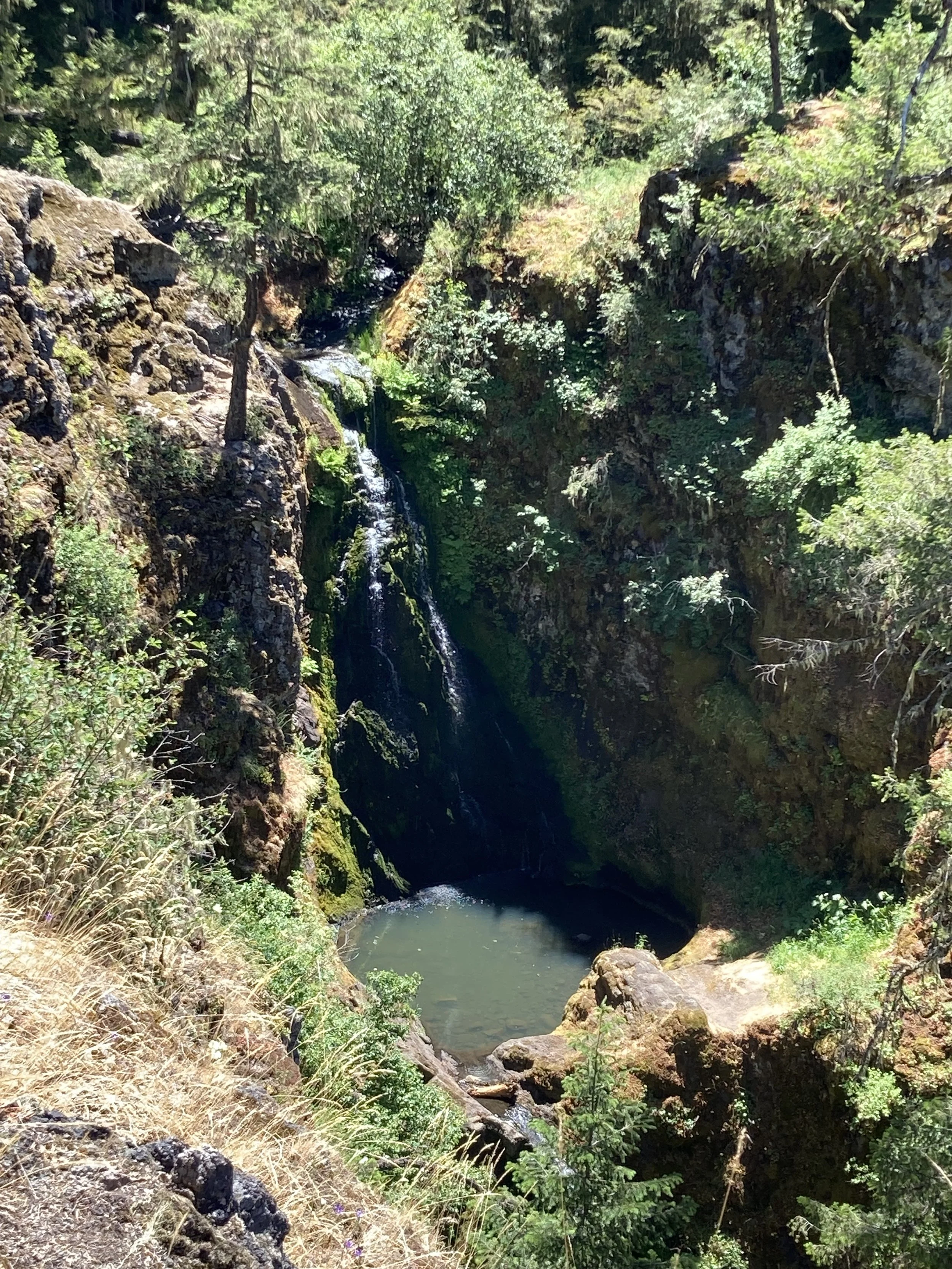
On Sunday, June 30th, 14 people met at the Rite Aid in Ashland to go to the famous Lost Creek Falls. After figuring out carpools, we took Dead Indian Memorial road, turning left onto Shale City Road. The lack of information on how to get to the trailhead is one of the reasons for Lost Creek Falls’ notoriety. Luckily the whole entourage arrived in one piece.
The main emphasis of the hike was on insects. Specifically, we focused on decomposers, which is basically anything that you would find under a log. However, slowly our attention shifted to pointing out any insects that were found along the way. We were even able to use Loupes to get a closer look at some of the creatures we found.
Photo credit: Val Rogers
While it is only about three quarters of a mile to get to the falls, we did need to cross the creek a few times. There was still a variety of wildflowers in bloom including western columbine and Oregon sunshine. A full list of all flowers and butterflies that were seen on the trail can be found at the end of this post. We were even able to spot many pollinators including a variable checkerspot butterfly as well as bumble bees. One of the best parts about this trail is the creek that the group followed the whole way. The gurgling creek paired with the sound of song birds proved magical. It was a great opportunity to show the importance of water to all different types of life.
One of the insects that we saw most often is the Spittle Bug. It is known for its frothy, spit-like liquid that they produce when feeding on plants. They were often found on the thicker stems of grasses. Once we arrived at the falls, we all took a moment to be in awe of its beauty. Using binoculars we were also able to spot a fully grown salamander at the bottom of the falls, about seven inches long! The group stopped here to rest and eat some food while we talked about the designation and the history of the Cascade- Siskiyou National Monument as well as everyone’s experiences in the Monument thus far.
After refueling, a small group decided to adventure out to an overlook on top of the bluff to hopefully catch a glimpse of Lost lake. It is the only naturally made lake in the Monumen that was formed when Lost Creek was cut off from the falls by a landslide.
It was a wonderful, quick morning hike. Everyone had a noteworthy time, filled with looking under rocks and investigating various flora. Certainly, it would have been difficult to think of a better way to spend the morning than exploring this special corner of the Monument.
Information in this blog post is from the presentation put on for the Friends of Cascade-Siskiyou National Monument by BLM Fish Biologist, Chris Volpe.
By: Zaynab Brown
If you have been following our organization for any length of time, you probably know that we are really into beavers. Beavers do amazing things for the landscape and those who live in it, including humans. You may have also heard the word “riparian” thrown around. In ecology, riparian is defined as relating to wetlands adjacent to rivers and streams. While we have touted the benefits of healthy riparian areas, it’s time that we learn more about the streams themselves. Who lives in these, sometimes ephemeral, waters and in what unique ways are they being impacted by changes to our climate and waterways? To answer these questions, the Friends recruited one of the best people for the job: Chris Volpe.
Chris Volpe is the Medford District and Ashland Field Office Fish Biologist. He has been with the BLM for 22 years and spent another four years prior to that in the Rogue Basin collecting fish and habitat data with the Oregon Department of Fish and Wildlife. Chris has been involved with monitoring, research, and restoration of aquatic species and habitats in the Cascade-Siskiyou National Monument for most of his career.
On Friday, June 14th, Chris and a room full of the aquatically curious gathered to gain a better understanding of the aquatic habitats and species of the Monument. This starts with understanding that, within the Monument, there are 724 miles of streams, 57 of which are fish-bearing! Of course, not all streams are flowing all year. Those streams are called “intermittent streams” and make up the majority at 455 miles compared to 268 miles of “perennial streams”, or streams that flow year-round. However, even intermittent streams provide important habitat, including for fish. Springs are also a type of free-flowing aquatic habitat that contribute high-quality water to the larger streams and provide unique habitat.
Not all aquatic habitat in the Monument is free flowing. You can also find 790 acres of ponded and slow water habitat. While most of this acreage is represented by large reservoirs such as Hyatt and Little Hyatt Lakes, there are also ponds and fens. Fens are rare, peat-accumulating wetlands associated with springs and are found in a couple locations within the Monument.
It is of no surprise, considering that the Monument was designated for its incredible biodiversity, that this diversity extends to its aquatic inhabitants. There currently are seven native fish species found within the Monument, amphibians including the Pacific Giant Salamander and threatened Oregon Spotted Frog, Western Pond Turtles, mammals such as beavers and river otters, as well as many species of mollusk and macroinvertebrates. The native fish include Speckled Dace, Tui Chub, Sculpin, Cutthroat trout, Redband trout (a subspecies of the rainbow trout), Jenny Creek Suckers, and migratory steelhead. Though this diversity may soon see an increase due to one of the biggest changes to the watersheds of southern Oregon and Northern California that has happened in quite some time.
If you have been following local news, you have most surely heard of the successful campaign to remove the dams on the Klamath River. This momentous accomplishment will have ripple effects on aquatic ecosystems far and wide, including in the Monument. A big winner may be the migratory fish species. Jenny Creek, which is part of the Klamath River Watershed, may now be colonized by both Steelhead and serve as a place for Chinook Salmon to spawn and rear. The future may also see Pacific Lamprey and Coho Salmon make a return. However, natural barriers like Jenny Creek Falls will still limit the extent that fish will be able to colonize streams within the Monument.
On Saturday, June 15th, participants got an opportunity to experience the aquatic life in Jenny Creek first-hand. It was a beautiful day as we watched Chris and Jenna Volpe don waders and a backpack that looked like it would sooner be found on the set of GhostBusters than a wild and scenic waterway. Yet this piece of retro-looking technology would allow us a rare peek at what lived below the water’s surface.
We stopped at a section of Jenny Creek where beaver dam analogues (BDAs) had successfully slowed and spread the water into a wide and murky pool. Chris jumped in, metal rod in one hand and net in the other, as he and Jenna methodically made their way slowly through the pool while releasing small amounts of electricity intended to stun any fish or amphibians in the vicinity, making them easier to catch. This method, called electrofishing, soon turned up results as Chris gently placed several specimens into a bucket containing water that Jenna was carrying.
Once back up on dry land, Chris carefully lifted out a small Redband Trout. Its silver scales and distinctive pattern glistened in the daylight. It was easy to picture it flitting through the water, glinting as it passed through dappled shade cast on the surface. Next, Chris lifted out the other star of the show: an adult Jenny Creek Sucker.
Jenny Creek Suckers are a unique “dwarfed” population of Klamath Small-scale Sucker, endemic only to Jenny Creek. This is due to the population’s isolation from other suckers by Jenny Creek Falls, a complete fish passage barrier to upstream migration. It was easy to see how the sucker was suited for life sifting through the bottoms of streams in search of algae with its dull brown color and muted appearance. Chris remarked that fish surveys this year had revealed an uncommon abundance of Jenny Creek Suckers, particularly juveniles. He speculated that it was due to an unusual high flow event in the creeks and streams this spring resulting in the reduction of the population of macroinvertebrates that also feed on the algae, allowing more food for the new generation of fish.
The next stop for the group was lunch at a nearby pond. This pond, the result of restoration work by the BLM in 2019 to excavate a historic pond that had been filled in by natural processes. The pond was then soon colonized by the Western Pond Turtle, a species that may soon be listed under the Endangered Species Act, and beavers whose lodge could be seen rising from the middle of the pond. As participants took their lunch, we all waited quietly, hoping to see a turtle pull itself out onto one of the many floating logs to bask in the afternoon sun. The turtles, notorious for their shyness and sensitivity to vibrations, remained elusive until someone spotted one out near the middle of the pond where it probably assumed our clumsy footsteps made us poor swimmers. Binoculars were passed around as we all got a chance to see the surprisingly large reptile.
However, with nearly all stories of ecosystems in the present day, there seem to be existential threats around every corner. This is also true for the aquatic ecosystems of the Monument. The fact is that fish, and other aquatic species, need water to survive. Major diversions transfer water from the Klamath Watershed to the Rogue Basin Watershed to increase irrigation for the Valley below. This results in significant reduction in the flow in lower Jenny Creek, as well as other creeks and streams in the Monument, often during the lowest-flow time of the year. Infrastructure that allows these kinds of diversions, such as dams, also often results in the complete aquatic organism passage barriers. Degraded water channels also become more efficient at moving water away from the landscape instead of storing it in flood plains and as ground water. This degradation is associated with many things including the removal of beavers, cattle grazing, reduced riparian vegetation, and roads, culverts, and ditches.
Of course, you cannot discuss water without acknowledging the role of long-term drought in reducing the overall amount of precipitation falling on the landscape each year. Many streams that were once considered perennial several decades ago are now intermittent and dry up most years. This reduces the available habitat for aquatic organisms.
Like most problems that are largely due to human activity, solving it also relies on the actions of humans. This includes process-based restoration, such as adding large wood/rootwads to waterways, low-tech process-based restoration such as beaver dam analogues and post-assist log structures (PALS), and the reintroduction of beavers onto the landscape. It is also important to consistently take inventory to determine the “what, where and how” of existing ecosystems processes and then monitor to evaluate the efficacy of restoration efforts. An citizen-science example of both of these is the recent Beaver Scavenger Hunt put on by the Friends to determine where beavers are currently in the Monument and what they are doing. The BLM also carries out work such as monitoring water quality and quantity and populations of aquatic organisms.
It can be too easy for land-loving humans to overlook the fascinating aquatic habitats and species. Yet these habitats often form the foundation of many important ecosystems in the Monument. While there is a very long road ahead to restore the majority of the waterways to healthy states, proven progress has been observed using the restoration strategies mentioned above. It now requires consistency of efforts from both the private and public spheres to emulate and restore the natural processes through funding and hands-on work.
If you would like more information and to get involved in aquatic and riparian restoration taking place in the Cascade-Siskiyou National Monument and surrounding area, please sign up for our newsletter and check out some of the work being done by other local non-profit organizations below.
The first Monument Day was a success! On Wednesday, June 19, students from The Crest Nature Camp at Willow-Witt Ranch visited the Cascade-Siskiyou National Monument for a day of sun and fun! Thirty-two students, ranging in ages from 6 to 11 years, trekked through fields of wildflowers and lush conifer forests.
Rangers Nora and Emily led hikes up Hobart Bluff, with great views of the Cascade and Siskiyou Mountains as well as the Klamath Basin and Rogue Valley. From the peak were great vistas of Pilot Rock and Soda Mountain Wilderness within the CSNM. Along the way, students made use of their nature journals to connect more deeply to nature. Great places to stop and take in their environment provided opportunities for mindfulness and connection.
We also explored the trail as naturalists, learning about the different habitats and tree species. We began through natural stands of white fir and Ponderosa pine, with more whimsical white and black oaks as we got lower in elevation and neared riparian areas. Above the tree line the aspect changed; we were now in the western extent of the Great Basin. Students studied juniper and sagebrush foreign to most of the valley. At the summit we enjoyed a feast for our hungry bellies and an eagle-eye view.
On the descent, we enjoyed trail games such as color matching since our ecosystem is nature’s canvas. Especially plentiful were the wildflowers. There were beautiful scenes of greens, reds and blues. We even passed a lovely slope full of the yellow Oregon Sunshine. Of course, with all the flowers, pollinators were a plenty. Grasshoppers, beetles, and butterflies, oh my!
After our hike, students participated in arts & crafts to flex their creative muscles. They made dragonfly pins from various household items. As a mixed age group, we helped each other make a buzzing menagerie of dragonflies. All in all, a really enjoyable day to spend in the summer. ?