
May 2023 Newsletter
To read about our latest news and events, please check out our May newsletter.
To read about our latest news and events, please check out our May newsletter.
April 6, 2023 – Monument Research Symposium
Every year, the Friends of the Cascade-Siskiyou National Monument is delighted to award a number of grants to undergraduate and graduate students for faculty-supervised research projects that enhance the understanding, appreciation, preservation and/or protection of the Cascade-Siskiyou National Monument. These research projects can, and have, taken many forms including the realms of biology, environmental sciences/education, sociology, arts, humanities, and business.
An essential component of receiving this grant is the presentation of the students’ research at our annual Monument Research Symposium. This research represents many hours spent in our beautiful Monument gathering data and then countless more analyzing it. To ask our three grant recipients from 2022 to distill all of their findings into a 20 minute presentation is no small feat, but they delivered with flying colors.
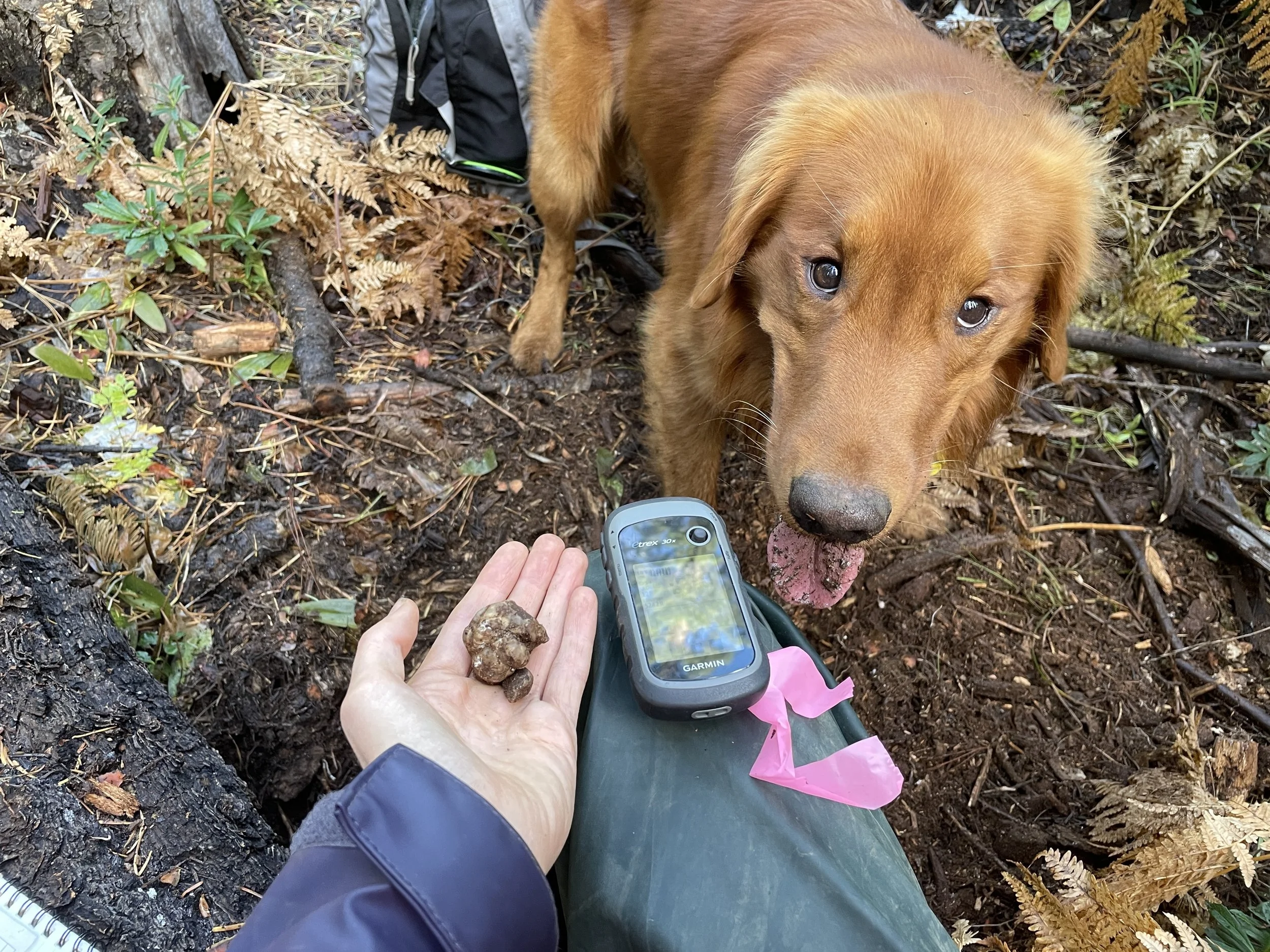
Our first presenter, Thomas Hillard, is an undergraduate student in Earth Science and Biology at the University of Oregon. He worked with faculty supervisor, Jad D’Allura to map out the rock formations in Jenny Creek Falls as well as a region of tuffaceous rocks, debris flow and lava around Pilot Rock. Specifically, he looked at upper oligocene volcanic stratigraphy in the Colestin Formation and Roxy Formation. Thomas gave us a unique insight into how the geology of the Monument can have a stark impact on the distribution of plants and soils via the movement of water.
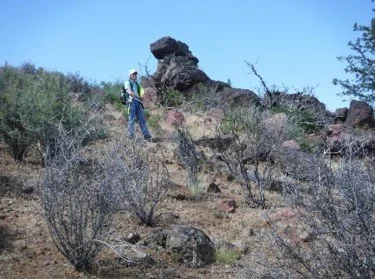
Our second presenter, Hilary Rose Dawson, a Ph.D. student from the University of Oregon, took a departure from geology to focus on biology, but still left us firmly grounded in the soil! Hilary used her Monument Research Grant to explore truffle species found in the Cascade-Siskiyou National Monument. Now, most people’s experience with truffles begins and ends in a culinary context, and while there are certainly a handful of culinary truffles found in Oregon, we also learned about the fascinating diversity of non-culinary truffles found just below the surface. These truffles have scents ranging from artificial banana to burnt rubber and serve a variety of essential ecological functions. However, humans aren’t exactly known for their sensitive noses so it was essential for Hilary –aided by her sister, Heather Dawson–to employ a canine friend named Rye! While not physically present at the symposium, you could definitely consider Rye one of the stars of the show. It was with his invaluable sense of smell, rewarded each time he found a truffle with a throw of a tennis ball, that Hillary was able to catalog around 20 species of truffles in only two forays into the Monument. She hopes to go on another foray with Rye this spring and continue DNA analysis of the truffles she has found, including some possibly undescribed species.
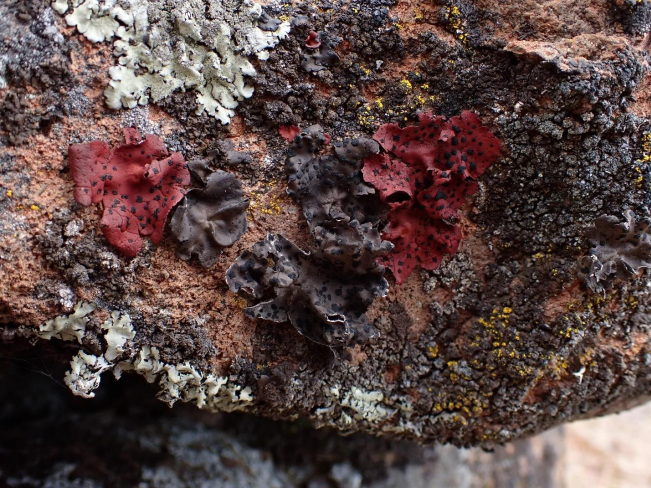
Our final presenter, Heather Stewart-Ahn, a Master’s student in Biology at Eastern Washington University, focused a sharp eye on an often overlooked resident of the Monument: Lichen! Lichen consist of a symbiotic relationship between a fungal partner and photosynthesizing partner, such as green algae or cyanobacterium. In particular, Heather looked at the rare lichen Umbilicaria phaea var. coccinea. This tiny but mighty lichen is most abundantly found on rocks in exposed areas with profuse basalt in proximity to local waterways. However, what really catches the eye is its bright red color, setting it apart from the much more common brown Umbilicaria phaea var. phaea. Through her survey, Heather identified several new sites within the Monument where this lichen is found and opened up many areas for further study including population genetics and distribution models to explore why it occurs in certain places and not others. There is also the basic query of why this lichen is red in the first place! This particular question is further complicated by Heather’s discovery of chimeric thalli, or lichen with both brown and red varieties found on the same thallus.
If you are interested in learning more about these projects, the symposium can be watched in its entirety on our YouTube channel at https://www.youtube.com/watch?v=CEePTxlJKnI.
With our 2023 Monument Research Symposium a resounding success, we are looking forward to getting to experience the unique projects that students will propose for this coming grant cycle. Applications are now open and information can be found at https://www.cascadesiskiyou.org/programs . The deadline for applications is May 12, 2023 at 11:59 PM PST.
February 24 & 25, 2023 – Hike and Learn
We had a full house for our Friday evening lecture despite snowy weather that prevented some from venturing down the mountain. Our leaders, Collette Streight and Robin Bliss-Wagner, kicked off the lecture by explaining that tracking, typically thought of as identifying an animal by looking at prints it left on the ground, is much more than that. We learned that tracking, when done in a holistic way, is about connecting with wild animals, building relationships with them, and understanding the world through their points of view.
Collette and Robin taught us that every animal makes a unique signature on the landscape. A signature is the collection of signs an animal makes when going about its daily life. Examples include tracks, scat, chews, scrapes, lodges, burrows, nests, hair, and feathers. We then learned the six main questions to ask ourselves when we encounter a track or sign to ignite our curiosity and lead us deeper into the animal’s world:
WHO made the track or sign? Was it a male or female? How old was he/she?
WHAT was she/he doing? Stalking, walking, trotting, galloping, leaping, stopping, sitting, turning his/her head?
WHEN was the track or sign made?
WHY was the animal doing what it was doing at that time and place?
WHERE did the animal go? Where is he/she now?
HOW did the animal feel when it made the track or sign? In other words, if this was me, how would I have felt?
Then we explored in detail the first question of tracking – who. We looked at photos, drawings, and field guides to learn about the individual prints and track patterns of many different animals who call the Monument home.
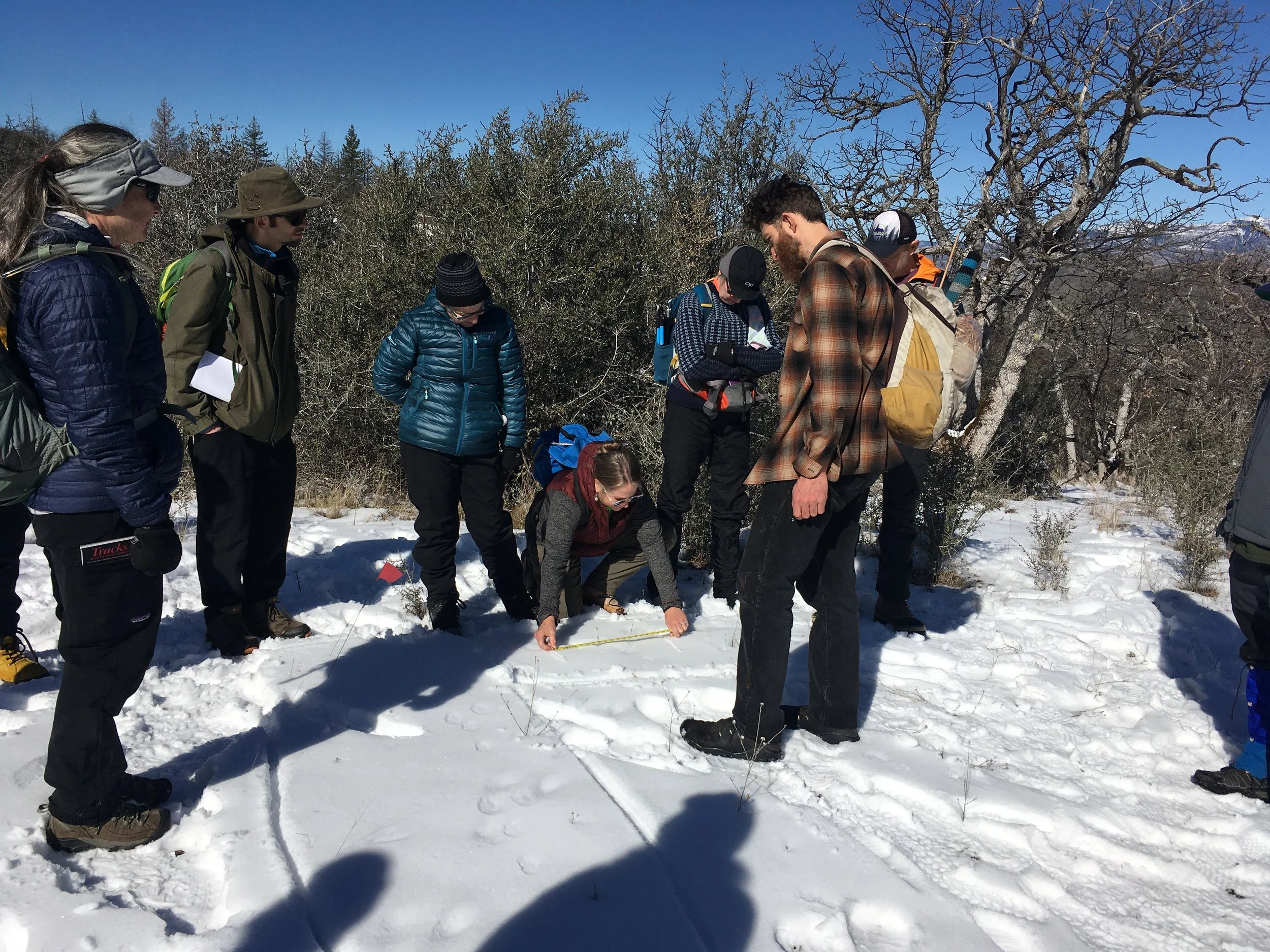
On Saturday, 15 of us carpooled up to the Buck Rock Tunnel trailhead in the glorious sunshine. On the way there, we stopped to examine a gray fox, who unfortunately had been killed by a car the previous night. We noticed its size, color pattern, shape, and then looked closely at the bottom of its feet and its claws before we continued on our way.
Equipped with field guides, tape measures, notebooks and pens, we explored the wildlife tracks and sign we saw in the snow in the parking lot, on the fire road, down in the ravines, up on the ridges, and in and around trees. We followed mule deer and brush rabbit trails to see where they would lead us. We asked questions, awakened our senses, listened to stories, played a game, and even spent some time pretending to be animals.
All and all, it was a beautiful, fun, and inspiring day during which we learned tools that we can use from now on to connect with and learn about the wild critters who live in the Monument and all around us.


January 20 & 21, 2023 – Hike and Learn
We kicked off our 2023 season of programming with a bang! Not only did our Bryophytes and Lichens of the Monument Hike & Learn with Scot Loring sell out, but each one of us who attended got to deepen our appreciation and knowledge of these wildly diverse and resilient organisms.
On Friday evening, we enjoyed a two-for-one lecture from Scot. He gave one lecture on bryophytes (mosses, liverworts, hornworts) and a second lecture on lichens. Scot taught us what each of these organisms are, explained the many ingenious ways they reproduce, and shared that they can live in the hottest, highest, coldest, and harshest places on Earth! Scot brought along some specimens that he’d recently collected so we got see, smell, and touch several different types of bryophytes and lichens.
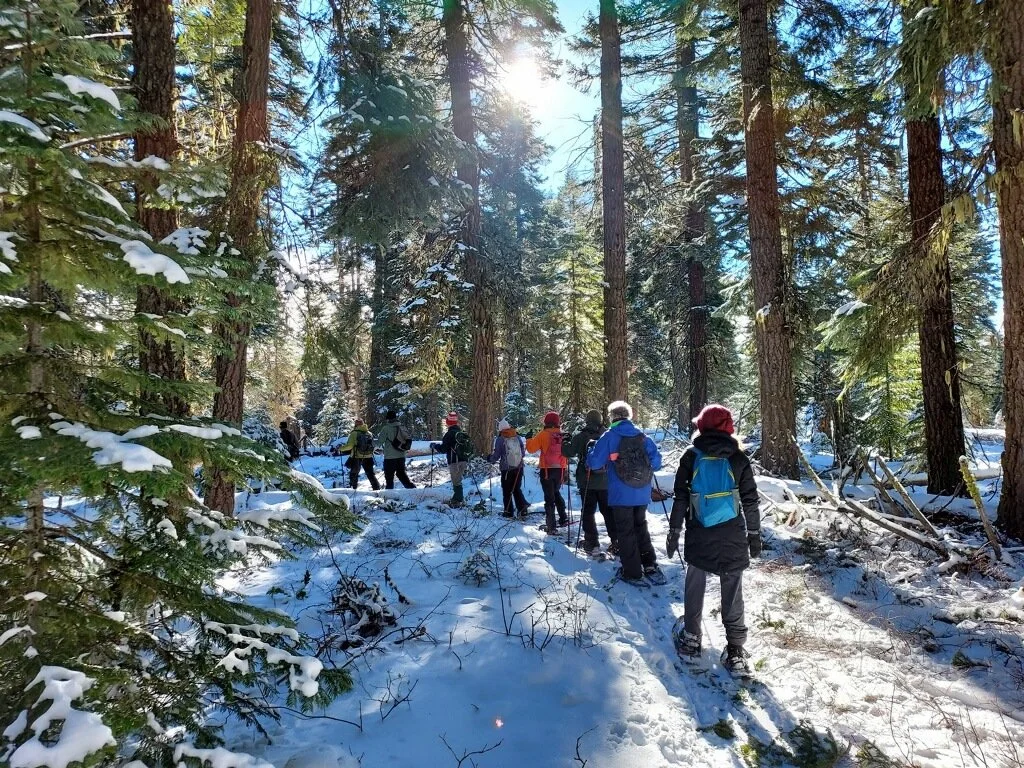
On the following day, 18 of us donned snowshoes and took a relaxed walk on the Pacific Crest Trail near the Hyatt Lake Campground in the sun and sparkling snow. Scot stopped us all along the way to look at the incredible variety of lichens and a few bryophytes we found growing on tree trunks and branches, rocks, stumps, and more. We used hand lenses, magnifying glasses, and the “magnifier” on our iPhones to get a close up look at some of the ones we spotted. We lunched under a lovely old conifer covered in lichens and shared stories, browsed through field guides, and basked in the warmth of the sun.
We’d like to give a shout out to the Medford District BLM and the US Forest Service for the loaner snowshoes. And, of course, a huge thank you to our Board member Scot for sharing his passion and expertise with us!


October 14th/15th Hike and Learn
The weekend of October 14 & 15, a small group of us were deftly guided by the dynamic writing workshop facilitator, Katie Boehnlein, to slow down, pay attention to nature through our senses, and write from our experiences and creative impulses. On Friday evening, Katie started by sharing with us some of her Monument-inspired writing to give us an idea of what is possible as well as to give us permission to play and be free with our writing.
Then, she prompted us with photos of different places and plant and animal species in the Monument as well as clips from the movie “Deep Green: Cascade-Siskiyou National Monument”. Deep Green, produced by Mark Tribe, is a 24-hour-long, single-take landscape film with immersive sound. She gave us time to write for several minutes after each prompt and when we were done, she invited us to share what we’d written with the group if we wanted.
It was fascinating to hear about what caught other people’s attention and to start to see things from their perspectives while listening to them read what they had just written. While it took a bit of courage to read aloud, Katie encouraged us to share the things that we liked about each other’s writing, which was both uplifting and emboldening. It definitely made us want to write more!
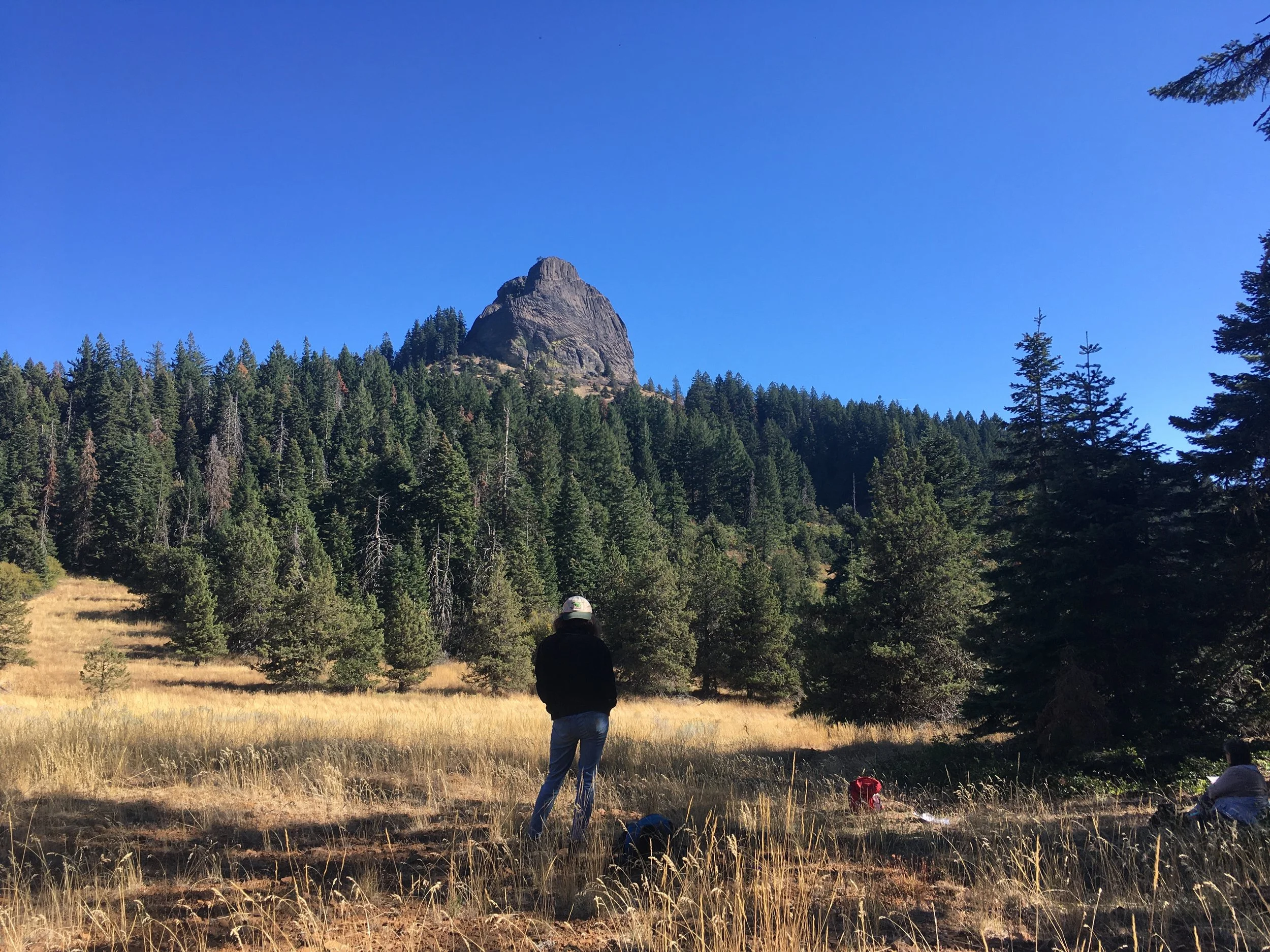
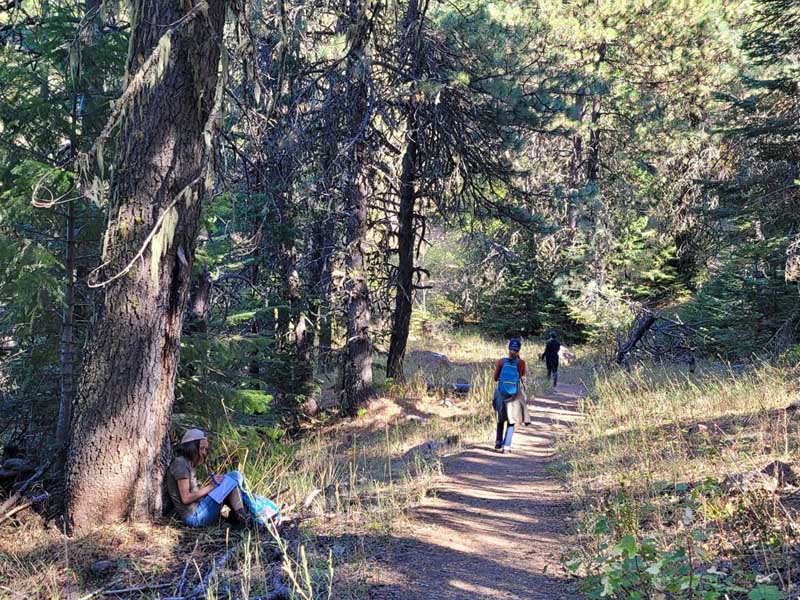
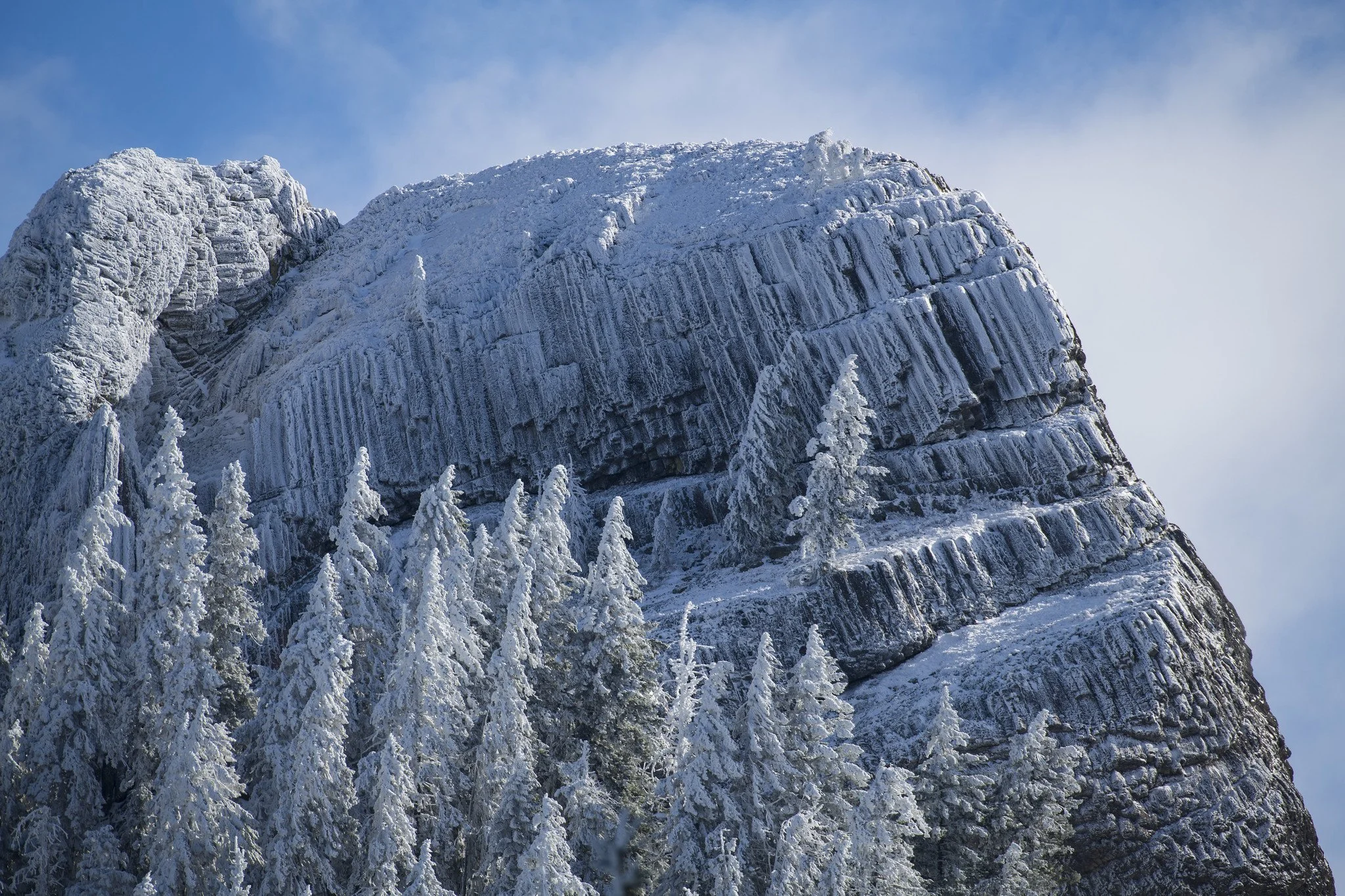
On Saturday morning, we drove to the Pilot Rock trailhead and made our way to the Lone Pilot Trail where, once again, Katie brought things to our attention that we would have missed without her. She flexed her naturalist and outdoor educator muscles to talk to us about the history, geology, and wildlife of the place. She had us be still and free write about what we experienced or write using the prompts she offered us. We got to share our writing again with one another and ended up feeling like New York Times bestselling authors when the other participants shared what they admired about our pieces.
It was a spectacularly beautiful day, and in the meadows and forest extending south of Pilot Rock, it felt downright magical, as we put pen to paper and wrote poems, creation stories, love letters, private thoughts, and more.
Words by Collette Streight, photos by Jonnie Dale Lieberman.




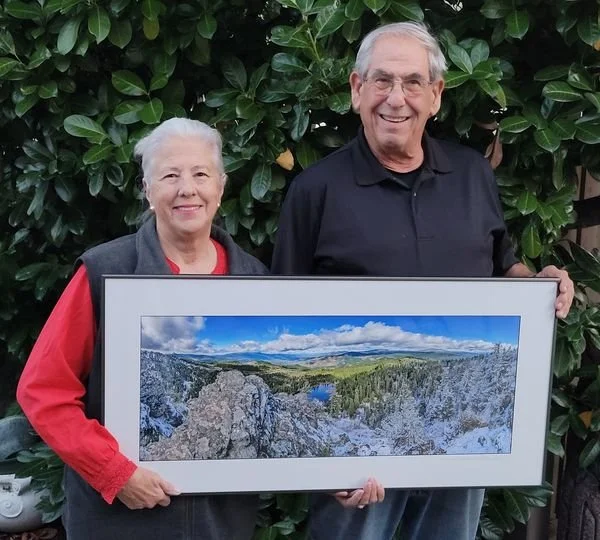
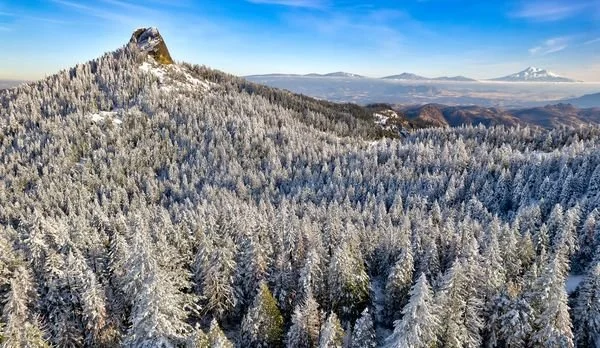
At our 2022 Gala on November 11th, the Friends of the Cascade-Siskiyou National Monument presented Suzi and Bob Given with a dramatic photograph of their property, taken from the top of Hobart Buff. The photograph is a 10-photomerged panorama taken by Al Case, photographer and SOU faculty, and fabulously printed to archival standards by Tom Glassman of Medford.
The photograph came with the following framed inscription: “We Honor Your Support, Inspiration, and Vision of the Friends of the Cascade-Siskiyou National Monument and Your Efforts to Protect and Increase Awareness of the Monument’s Biological Diversity, Landscape, and Cultural History”.
The Friends Board of Directors also announced that it has named all of its outreach programs in Suzi’s honor. From now on they will be called THE SUZI GIVEN COMMUNITY EDUCATION PROGRAMS, which will include: Youth Summer Camps, Summer Interpretative Ranger Programs, Inspiring Connections Lectures, Hike & Learns, and the Sunday Hiking Series. This will include our collaborations with SOU’s Environmental Education Program, Environmental Science & Policy Program, and Native American Studies.
There are few people that have done as much as Suzi and Bob to support the Monument and the Friends of the Monument. Besides their support for our mission to inform, educate and support the protection of the Monument, Suzi and Bob have supported and funded both land acquisitions and conservation easements in and around the Monument, environmental education programs with the Friends of the Monument, and many other programs in our community and elsewhere.
Both of them are leaders in the Green Springs Community. Bob has been instrumental in his work with the Green Springs Rural Volunteer Fire Department; the fire station is literally named after him. Suzi was one of the original members of the Friends of the Monument back in 2001 and for most of the time since she has been on our Board of Directors. Suzi also has been a strong community advocate and has been a large part of the leadership of the Friends of the Green Springs nonprofit group for many years.
Thank you Suzi and Bob for all you do!
We are thrilled by the success of our Friends Gala. To those of you who came out on November 11, 2022 to celebrate with us and support us, thank you! It was a festive evening of camaraderie, connection, delicious food and drinks, fundraising, and “Friends”raising in the Grand Ballroom at the beautiful Ashland Springs Hotel.
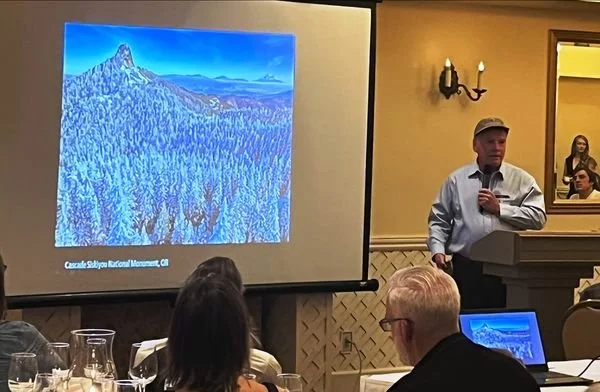
We’d like to give a special thank you to Bob Wick for an inspiring and informative presentation. According to Bob, former Wilderness Specialist and Outreach Coordinator for the Washington office Bureau of Land Management National Conservation Lands, “The national monument encompasses a really cool area south and east of Ashland and was designated specifically because of its biodiversity. In addition to being a national monument, the area includes a segment of the Pacific Crest Trail, CA-OR National Historic Trail, designated wilderness and a wild and scenic river — a grand slam of conservation designations. Species from the Cascades, Klamath Ranges and Great Basin all intermingle here. The Friends of Cascade-Siskiyou do a great job helping protect and interpret the area.”
We are also grateful for the businesses and individuals who donated items and services to our silent auction, the wineries who poured wine and donated wine for the Gala, and the volunteers who helped us pull off the event. We couldn’t have done this without you.
All in all, we feel very lucky to be a part of such a passionate community of like-minded folks who hold the Cascade-Siskiyou National Monument near and dear to their hearts.
To read about our latest news and events, please check out our November newsletter.
September 16th/17th Hike and Learn
On Friday evening, Jeanine Moy, director of the Vesper Meadow Education Program, gave an inspiring talk sharing the details of how the organization came to be and all that they have accomplished in the Vesper Meadow Restoration Preserve since 2018 when it was established. The preserve is composed of two interconnected upland wet meadows surrounded by mixed conifer forest in the southern Cascades. The parcels total about 1,000 acres and are bordered by the Monument and other BLM lands.
Jeanine stewards the preserve and organizes opportunities for the community to get engaged in hands-on restoration projects outdoors. Additionally, there are tribal partnerships for native food cultivation, environmental education programs, community science and monitoring projects, and a growing list of artists-in-partnership that contribute to the network.
On Saturday morning, we started our hike at Buck Prairie II, a popular cross-country skiing destination in the Monument. We hiked along an old wagon road to the restoration site, admiring native grass species like Roemer’s fescue (Festuca roemeri), and savoring the delicious scents of the seeds of yampah (Perideridia spp.) and Lomatium. Elk enjoy roaming these meadows, evidenced by the tracks we noticed in the mud.
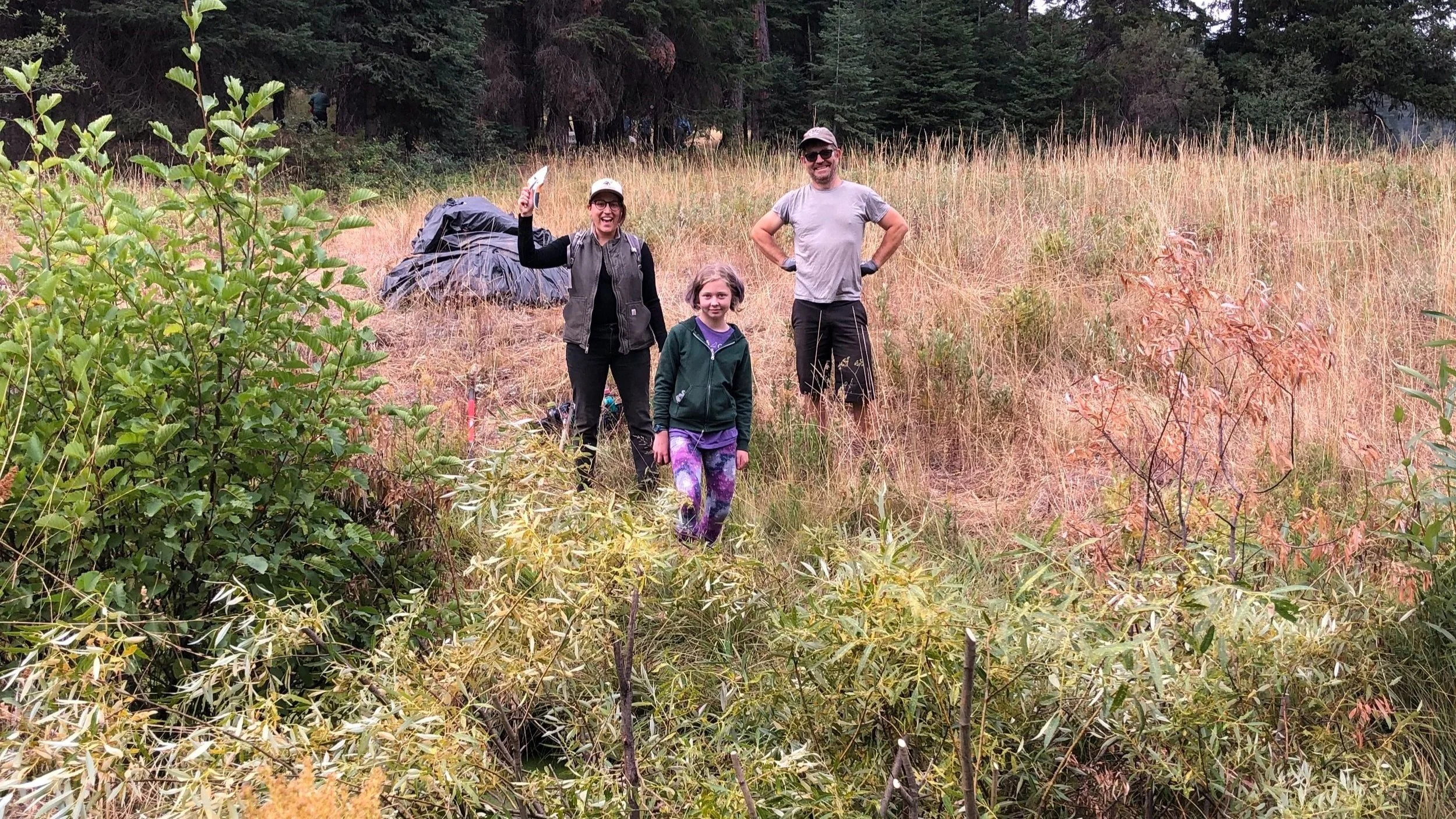
Once we arrived at Latgawa Creek, the work began: low-tech process-based restoration strategies. In other words, we behaved like beavers! Beavers impact natural stream flows and transform landscapes by gnawing down trees and building dams and lodges; they were a big part of this ecosystem before cattle arrived on the scene. We mimicked this natural process by cutting back shrubby willows (Salix spp.), planting the cuttings in the creek as if they were stakes, and weaving smaller branches to create a blockage in the creek. This will aid in sediment deposition; in many places the creek’s bottom is down to bedrock, which is not ideal for aquatic creatures or plants trying to regenerate along the waterway. It will also aid in water retention in the meadow by slowing down the water and allowing it to spread and sink on the land. There is much more work to be done on the preserve as well as throughout the Monument, so please look out for ways you can plug in to help.
The Friends would like to thank Jeanine and Vesper Meadow for offering a fascinating learning experience and collaborating with our community on this project.


